Making room for important work

I want to be responsive without letting every incoming request decide what I work on next. That’s an easy intention to have and a harder one to put into practice. Urgency and importance can feel like the same thing, especially when someone is waiting for an answer.
Tactical work often does need attention. A blocked team, a problem affecting customers, or a decision with an approaching deadline can deserve an immediate response. But leaders also have a responsibility to think further ahead. If strategic thinking only happens after everything else is handled, it has a pretty weak claim on the day.
Harvard Business School Online’s article on prioritizing tasks with the Eisenhower Matrix prompted this project. The idea I wanted to put into practice was separating two judgments that are easy to collapse into one: how much something matters, and how soon it needs attention.
What the Eisenhower Matrix is
The matrix is a two-by-two grid. The columns separate urgent work from work that isn’t urgent; the rows separate important work from work that isn’t important. Each task goes into one of the four boxes, or quadrants, based on those two judgments.
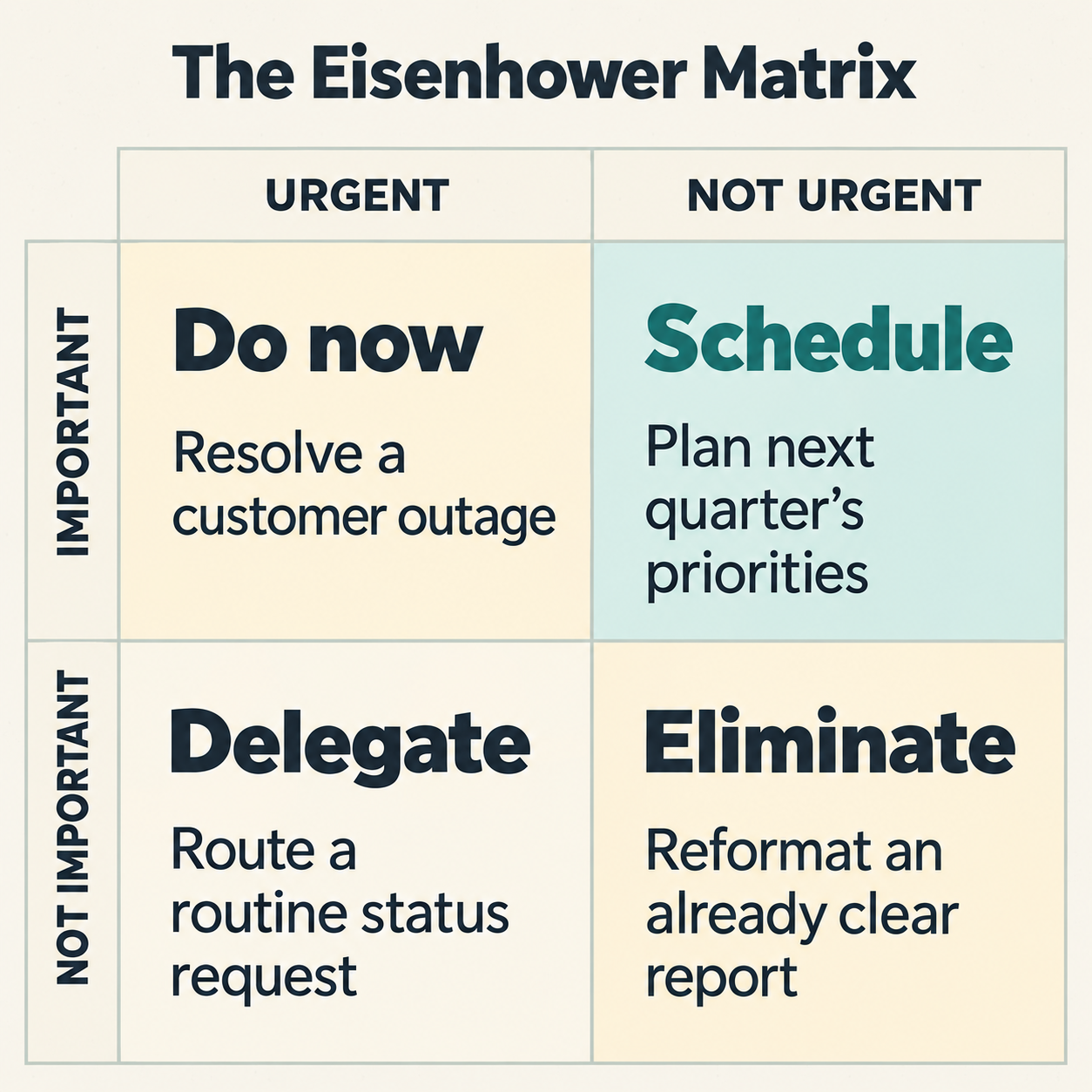
Importance is about the work’s effect on the outcomes you’re responsible for. Urgency is about how soon it needs attention. The combination suggests a response:
- Important and urgent: do now. The work matters, and waiting has a cost.
- Important but not urgent: schedule. Protect time for it before a deadline or a problem forces the issue.
- Urgent but not important: delegate. Find an appropriate owner for time-sensitive work that doesn’t need your involvement.
- Neither important nor urgent: eliminate. Question whether the work needs to happen at all.
A problem affecting customers today might belong in the first box. Planning how to prevent that problem from recurring might belong in the second. Both can matter a great deal, but they need different responses. That’s what I want the matrix to make visible before I start working through a list.
Ask about importance before urgency
I like starting with importance because a deadline is such a persuasive detail. Once I’ve noticed that something is due today, it’s tempting to treat the question of whether it deserves my time as already answered.
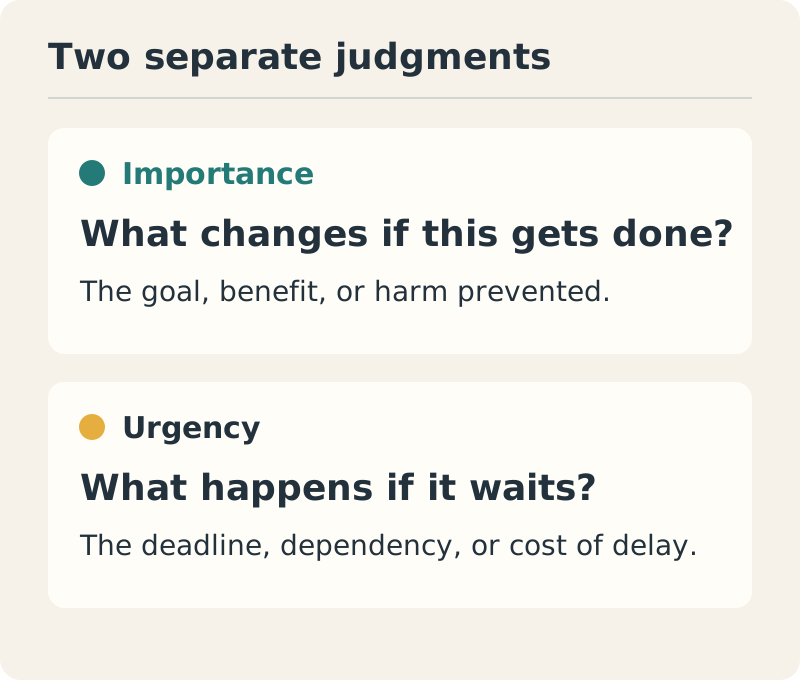
The first question is: What changes if this gets done?
I want a concrete answer. It could move a goal forward, prevent meaningful harm, help someone make a better decision, or give a team a capability it will need later. “Someone asked for it” explains how a task arrived. I still need to understand what the work is supposed to accomplish.
Then I ask: What happens if it waits?
That makes urgency more specific. Is there a real deadline? Is someone unable to proceed? Will a delay make the problem materially worse? Sometimes the answer is yes, and acting quickly makes sense. Sometimes “urgent” means the request arrived recently or has been repeated a few times. Those deserve different responses.
Researchers Meng Zhu, Yang Yang, and Christopher K. Hsee found a related pattern in five experiments: people sometimes chose tasks with lower payoffs when those tasks appeared to expire sooner. They called it the mere urgency effect. Those were controlled experiments, not a test of how well managers lead, but they give me another reason to pause before treating time pressure as evidence of value.
Choose a response, then decide who should act
Once I’ve placed a task in the matrix, I still need to decide what the response involves and who should handle it.
Work that’s both important and urgent needs attention. That doesn’t automatically mean I should do every part of it myself. A leader might need to make a decision, remove an obstacle, or make sure the right person has what they need. Taking ownership of the outcome can involve a much smaller intervention than taking over the whole task.
For an urgent request with limited impact on the goals I’m responsible for, I would look for an appropriate handoff, a shorter response, or a different expectation about timing. Delegation needs an owner, a clear outcome, and an agreed time to respond. Moving a task into a box doesn’t provide any of those things by itself.
There’s also a judgment to make before calling work unimportant. A request may matter a great deal to someone else. A leader’s job includes understanding those dependencies, not just protecting their own list. “Not important to me” is too convenient a test.
Work with little consequence and no time pressure is worth questioning more directly. An unnecessary status update or another formatting pass on a document that already does its job might be something to stop. Removing it should be an explicit choice, so it doesn’t stay on the list indefinitely as a small obligation nobody has reconsidered.
Give strategic work a next step
The part I care most about is important work that hasn’t become urgent. Thinking through a team’s direction, developing people, or addressing a recurring source of friction can be easy to defer because the consequences of waiting are less immediate.
This is where “schedule” needs to mean more than “later.”
For example, “improve how the team makes decisions” is a worthy intention, but it’s too broad to compete with a concrete request. “Draft the decisions the team can make without an escalation” gives me a place to start. I can set aside time for it and know what I intend to produce.
I’d protect that time in the calendar I already use. If an urgent problem displaces it, I’d choose another time while making that tradeoff. Otherwise, the interruption gets a decision and the strategic work simply disappears.
I also want to connect repeated urgent work to a possible longer-term response. If the same kind of escalation keeps coming back, handling the next one may be necessary today. Clarifying ownership or changing the underlying process could make future escalations less likely. Those are two distinct tasks, and both deserve a place in the plan.
Tactical work can be important, and strategic work can become urgent. The distinction is about consequence and timing, not a rule that puts every operational task below every strategic one.
What Eisenhower actually said
The name has an interesting wrinkle. In an August 19, 1954 address to the World Council of Churches, Dwight D. Eisenhower repeated a remark from an unnamed former college president:
“The urgent are not important, and the important are never urgent.”
Eisenhower was quoting someone else. The speech also doesn’t establish that he invented the four-box diagram we use today. The modern time-management matrix is part of Stephen R. Covey’s Habit 3, Put First Things First, which emphasizes making time for important work before immediate demands crowd it out.
I wouldn’t take the quoted line literally; plenty of situations are both urgent and important. What interests me more is Eisenhower’s own follow-up. He asked the assembly to help “give the important the touch of urgency.” In a speech concerned with lasting peace, he was making a case for attention to work beyond the next crisis. That strikes me as a useful responsibility for leaders at a much smaller scale, too.
Reconsider the list as circumstances change
I think this works best as a brief decision process I can return to. Start with the outcomes I’m responsible for. Look at the tasks against those outcomes. Ask what would happen if each one waited. Then decide what needs action, who should act, and which important task deserves protected time.
The classifications can change. A dependency can turn a previously flexible task into an urgent one. A change in direction can make a once-important deliverable unnecessary. Reconsidering it is part of the process.
If everything still lands in “do now” after an honest review, sorting has reached its limit. There may be a capacity problem or conflicting commitments to resolve. Choosing what will wait, and communicating that choice, is part of the work of leading.
What I’d want to see over time is that important work gets started while there are still options. That means looking beyond the number of boxes checked and asking whether time went toward the outcomes I meant to advance.
Putting it into practice
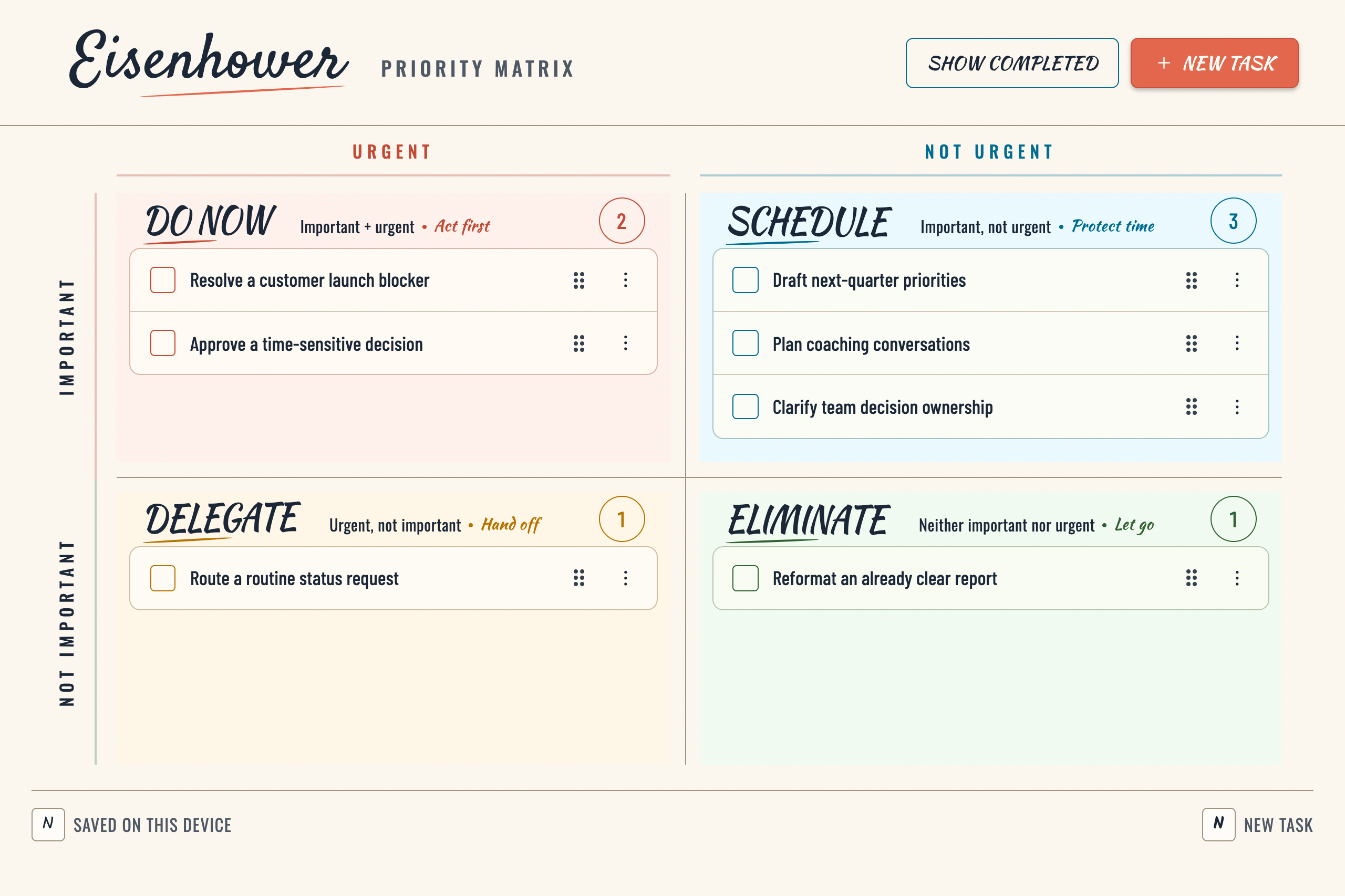
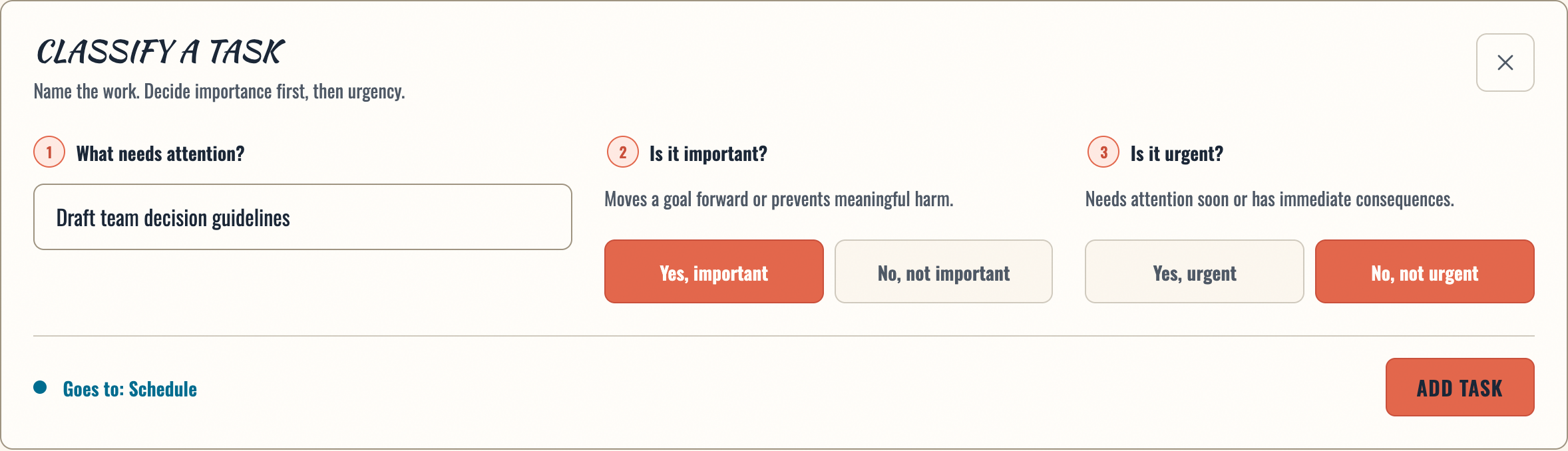
I made a small tool to put this process into practice. It asks those two questions, places the task in the matrix, and lets me move or reorder it when my judgment changes. Tasks stay in the browser, with no account required. You can try the Eisenhower Matrix or look through the source on GitHub.