Pen Pals #1: Down the Rabbit Hole
Rediscovering fountain pens, falling for expensive writing instruments, and doing an unreasonable amount of research to buy a $30 pen.
I’ve always had a thing for nice pens.
Not necessarily an expensive-pen thing. More of an appreciation for a good writing instrument. Something that feels substantial, writes beautifully, and makes the otherwise mundane act of taking notes a little more enjoyable.
In college, I had a Lamy Safari fountain pen that I absolutely loved. I bought bottled ink, refilled it myself, and generally enjoyed the whole ritual. There was something satisfying about it. I don’t remember exactly when I stopped using it, but somewhere after graduation, fountain pens quietly disappeared from my life.
Over the years, I’d occasionally flirt with getting back into them. I’d pick up a disposable Pilot Varsity, enjoy it for a while, and inevitably lose it. Every so often, I’d order some inexpensive Chinese fountain pen from Amazon, hoping to recapture what I’d liked about the Safari. Those were usually disappointing, and they eventually disappeared too.
It didn’t help that I’m left-handed. Fountain pens and lefties have a somewhat complicated relationship. Depending on the pen, ink, and paper, the experience can range from wonderful to a smudgy, scratchy mess.
So for years, I mostly stuck with ordinary pens.
For the past year or so, I’d been carrying Zebra pens as my everyday writers. They were inexpensive, looked decent, and seemed like a reasonable step up from whatever disposable ballpoint happened to be lying around.
Unfortunately, I was never particularly impressed with how they wrote. And the pocket clips were an even bigger problem. They just didn’t hold securely enough, which meant I was constantly losing pens.
Apparently, I’m perfectly capable of losing a pen without it being a fountain pen.
That experience did teach me something, though. If I was going to spend more money on an everyday pen, writing quality wasn’t the only consideration. I wanted something that felt good in my hand, wrote consistently, and had a clip I could actually trust.
An unexpected gift
My renewed interest in pens really took off recently when I left my previous job.
As a parting gift, I received a Montblanc PIX rollerball. It was an incredibly thoughtful gesture, and it’s a pen I’ll cherish forever. I’d admired Montblanc pens for years, but owning one was something else entirely.
Unfortunately, I immediately ran into a problem.
My everyday work notebook is a Moleskine tucked into a Saddleback Leather cover that I’ve used for years. I love the combination. But the Montblanc rollerball refill and the Moleskine paper did not get along. The ink skipped constantly, leaving frustrating gaps in my writing.
A luxury pen that couldn’t reliably write in my favorite notebook. Wonderful.
After a little experimentation, I swapped the rollerball cartridge for a Montblanc fineliner refill. Much better. The pen now writes beautifully, and I can actually enjoy using it.
I also got a really nice GitHub-branded rollerball that I’ve become quite fond of.
Suddenly, I was paying attention to pens again.
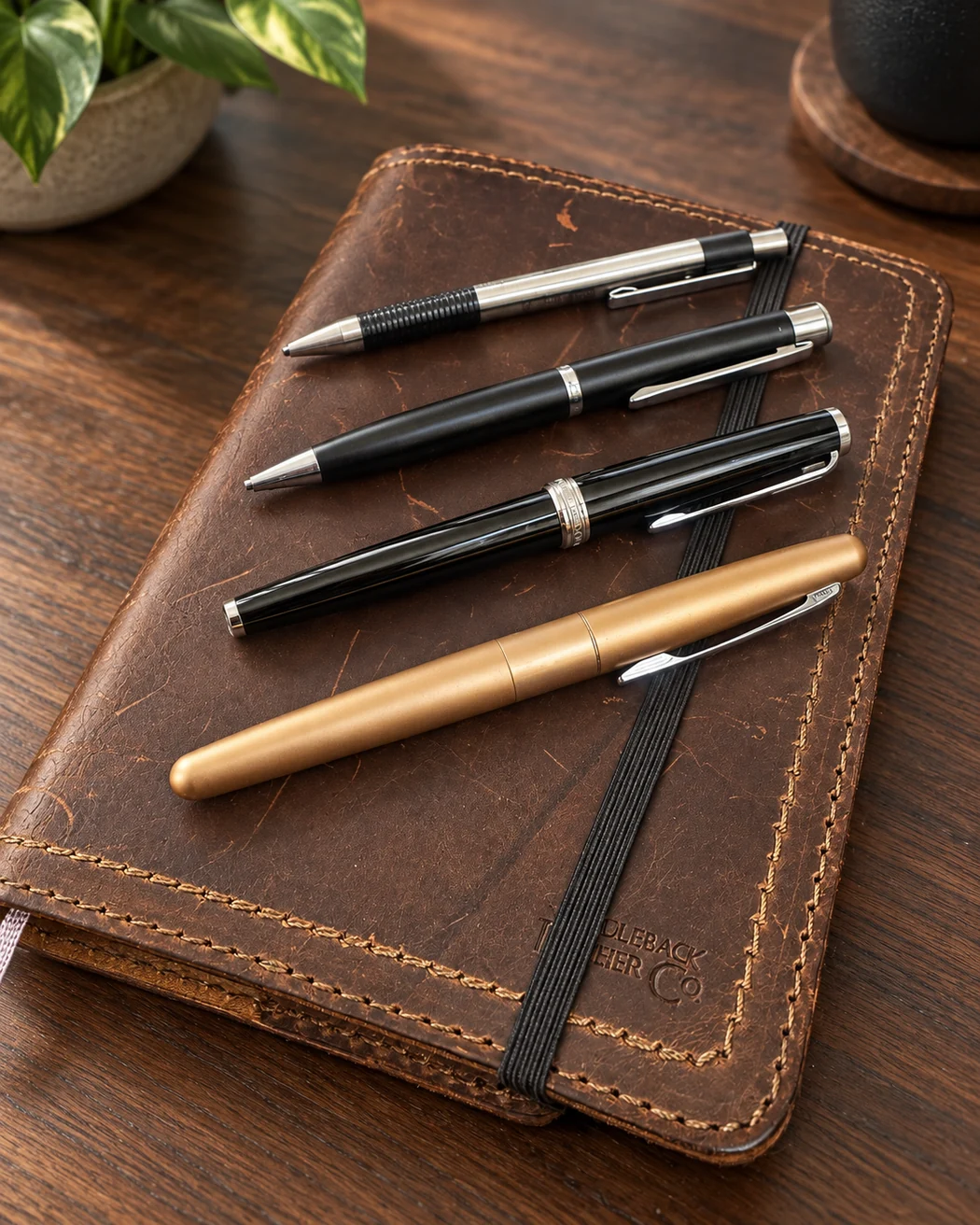
My current lineup, resting on the Saddleback Leather cover that’s been with me for years.
The ones that got away
The truth is, I’d never completely stopped thinking about fountain pens.
For years, a blue Sailor Pro Gear has sat on my mental wish list. I’ve admired the Montblanc Meisterstück 149 from afar for even longer. There are pens that I have absolutely no practical reason to own, but that doesn’t stop me from wanting one.
And now I’m getting curious again. About nibs, inks, materials, filling mechanisms, and the seemingly endless variety of pens that people are willing to spend ridiculous amounts of money on.
But before I start contemplating anything extravagant, I wanted something simpler.
A nice fountain pen I could actually carry around every day.
Something that felt good, wrote well, looked reasonably sophisticated, and wouldn’t completely devastate me if I left it in a coffee shop.
An unreasonable amount of research for a $30 pen
You’d think this would be a fairly straightforward purchase.
It wasn’t.
I had a few requirements.
First, it needed to be comfortable for a left-handed writer. I don’t need a specially designed left-handed pen, but I’ve learned that nibs, ink flow, and paper make a huge difference. And because I primarily write in a Moleskine, I wanted something that wouldn’t immediately turn every page into an ink-soaked disaster.
Second, I wanted something that felt like a nice pen. Not necessarily expensive, but well-made. A bit of weight, a good finish, and a design that wouldn’t look out of place next to the Montblanc.
Third, it needed to be practical. After sacrificing an alarming number of Zebra pens to the mysterious forces that remove things from pockets, I’d developed a real appreciation for a secure clip. I’m remarkably good at losing pens, so this wasn’t going to be something I’d worry about every time it left my desk.
And finally, I wanted something inexpensive enough that I could experiment without feeling committed to it forever.
There are quite a few good fountain pens in that category.
The obvious choice was another Lamy Safari. I already knew I liked it. It’s lightweight, durable, has a wonderfully functional clip, and even offers a left-handed nib option. There was also something appealing about returning to the pen that started all of this.
But I wasn’t really looking to recreate my college experience. I wanted to try something new.
The Kaweco Sport was another intriguing possibility. It’s a classic little pocket fountain pen with a distinctive octagonal shape. Compact, portable, and designed to go just about anywhere. But the standard plastic version didn’t quite match the more substantial, traditional pen I had in mind. The clip is also an optional accessory rather than an integrated part of the pen.
Then there was the Platinum Plaisir, an inexpensive aluminum fountain pen with a clever cap mechanism designed to keep the ink from drying out. That sounded particularly useful for someone who might go a few days without using a fountain pen. Sensible, practical, and probably a perfectly good choice.
The TWSBI Eco appealed to a different part of my brain. It’s a piston-filling fountain pen with a large ink reservoir, and its transparent barrel lets you see the ink sloshing around inside. As someone who once enjoyed messing around with bottles of ink in college, that was tempting.
But it felt a little more like a hobby pen than the understated everyday writer I was after.
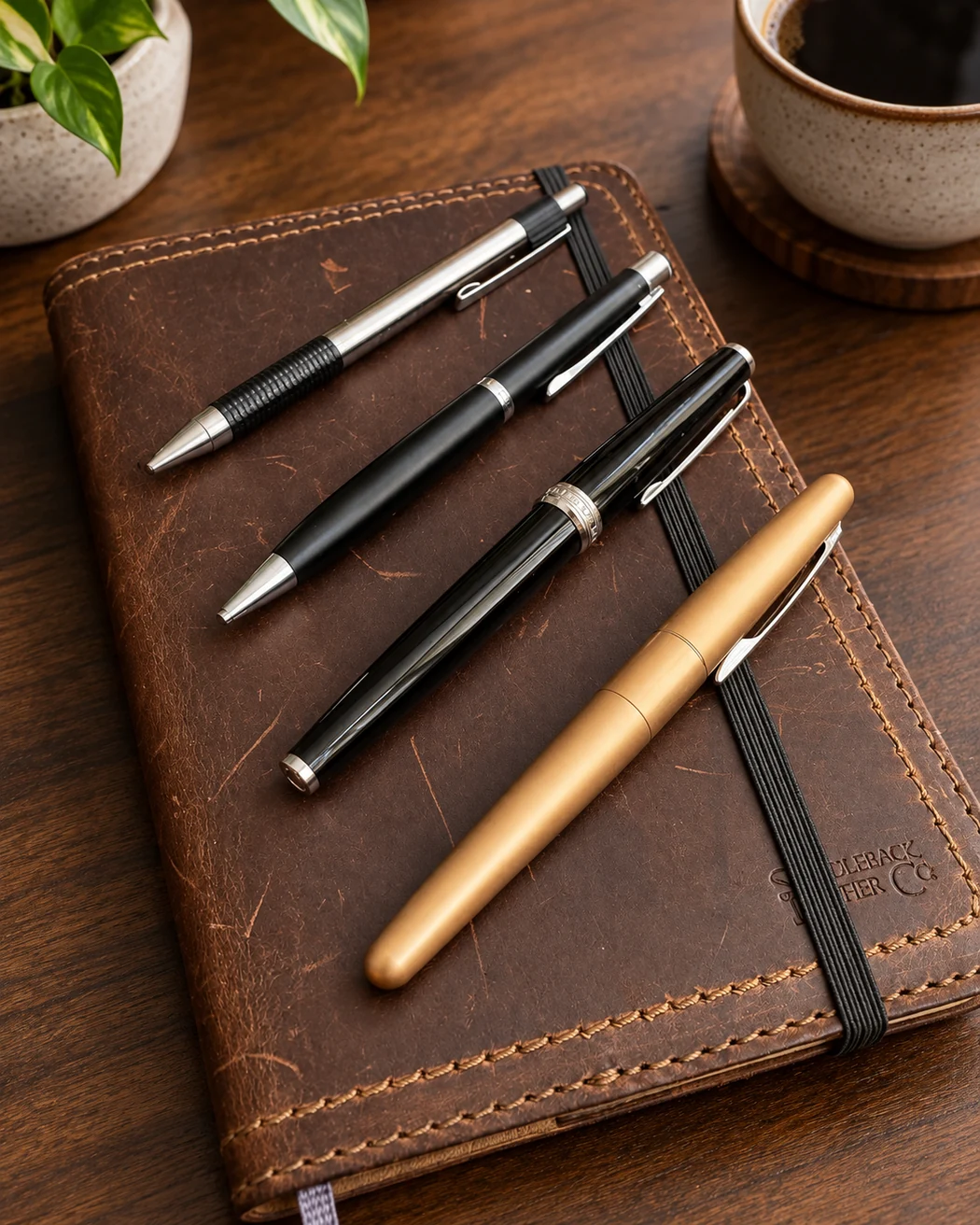
The current pen lineup. I’m trying to keep the collection somewhat more practical than the wish list.
I also kept running into recommendations for the Pilot Metropolitan.
And the more I looked at it, the more it seemed to check the right boxes.
Unlike many inexpensive fountain pens, the Metropolitan has a brass body. It has a little heft to it, a clean, relatively conservative design, and a stainless steel nib. Nothing especially exotic, but it looks and feels like it belongs in a more expensive category.
Pilot also has an excellent reputation for its entry-level nibs, which mattered more to me than fancy materials or elaborate filling mechanisms.
The Metropolitan uses a conventional cartridge or converter rather than an elaborate built-in filling system. That suits me fine. I can keep things simple with cartridges or eventually break out the bottled ink again.
It also has a proper metal pocket clip. Whether that clip will actually prove more reliable than the ones on my Zebras is something I’ll have to find out, but at least it looks promising.
Most importantly, it’s inexpensive. Not disposable-pen inexpensive, but reasonably priced enough that I’d actually use it without constantly worrying about it.
I could throw it in my bag, clip it into a pocket, take it to a coffee shop, or use it during a meeting. If it got scratched, that would be character. If I lost it, I’d be annoyed rather than heartbroken.
That feels like the right place to start.
So after an entirely disproportionate amount of reading, comparing, and second-guessing, I went with the Pilot Metropolitan.
Whether it actually gets along with my left-handed writing, beloved Moleskine, and apparently pen-eating pockets over the long run remains to be seen.
Which, I suppose, gives me something to write about next.
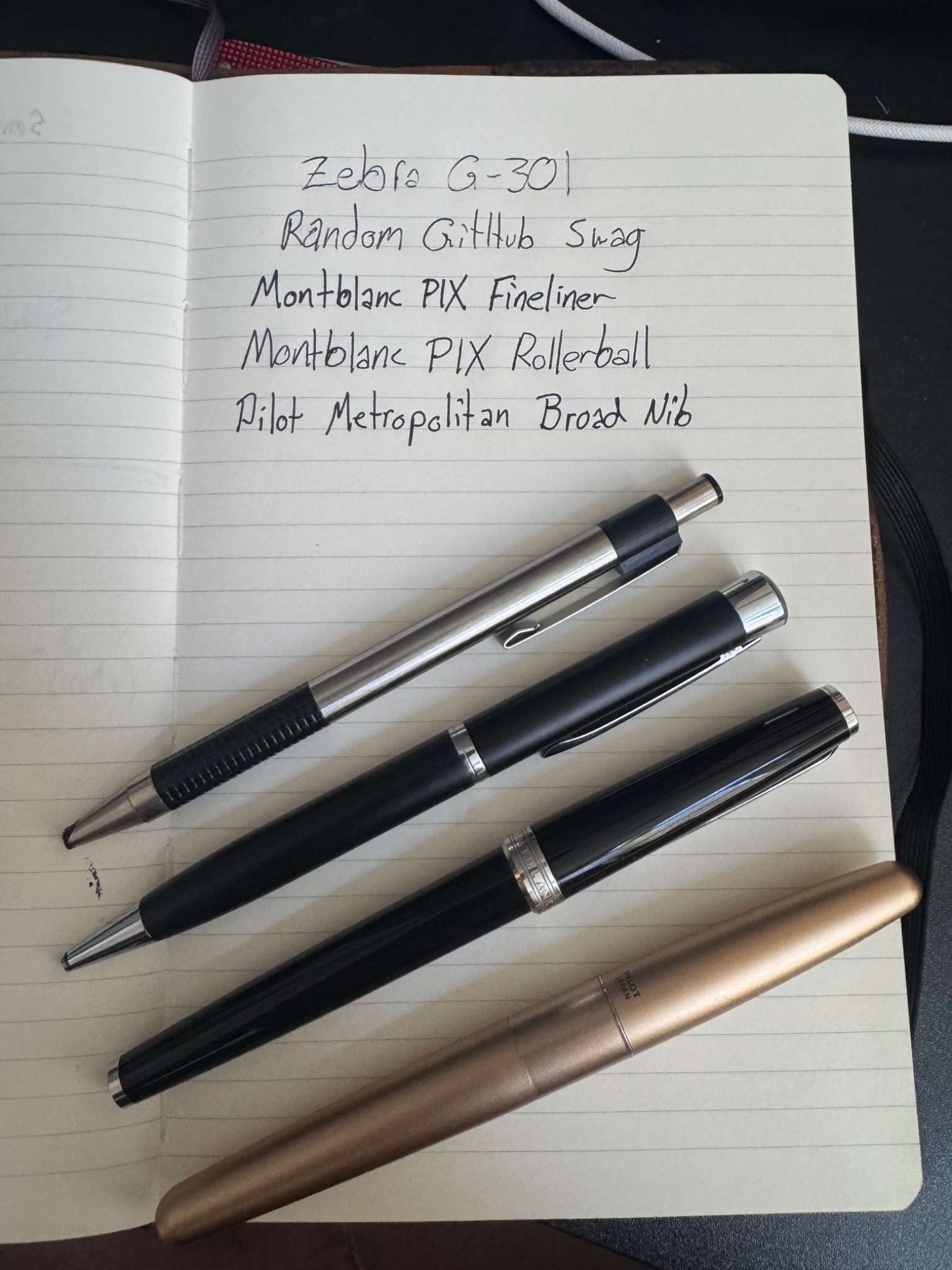
An early writing comparison. There’ll be more to say about how these actually perform.
Enter Pen Pals
That’s what this series is going to be about.
I’m not a pen expert. I don’t have a massive collection, encyclopedic knowledge of nib grinds, or strong opinions about obscure Japanese inks. At least not yet.
I’m just someone who enjoys a good pen and wants to explore what makes some of them special.
I’ll write about the pens I buy, the ones I want, what works for a left-handed writer, and what happens when supposedly beautiful writing instruments encounter the reality of my everyday notebooks.
And it probably won’t be exclusively about fountain pens. Rollerballs, ink, paper, notebooks, and anything else that makes writing a little more enjoyable are all fair game.
There will probably be some inexpensive discoveries, some disappointments, and maybe eventually a few truly extravagant purchases.
For now, I’m starting with a Pilot Metropolitan and seeing where this takes me.
Hopefully, I can manage not to lose it.