Open Source Spotlight #2: NEO — When the Expert Becomes the Builder

How a bestselling novelist turned a nine-year-old idea into an open-source writing app.
One of the things that excites me most about AI-assisted development isn’t that developers can write code faster. It’s that people who aren’t developers can increasingly build the software they’ve always wished existed.
For years, building specialized software meant finding someone who understood the problem and someone who knew how to write the code. Sometimes those were the same person, but often they weren’t. A developer might spend months learning the nuances of an unfamiliar industry, while the person who understood those nuances struggled to communicate exactly what they needed.
What happens when the person who knows the problem best can build the solution themselves?
That’s what caught my attention about NEO, a free, open-source word processor created by Hugh Howey, the bestselling science fiction author behind Wool and the Silo series.
Howey isn’t a professional software developer. He’s a novelist who spent nearly a decade imagining his ideal writing application. In 2026, he finally built it with the help of Claude.
Nine years in the making
In July 2017, Howey published a blog post describing his dream word processor.
He’d tried Word, Pages, Scrivener, and plenty of other writing applications. Some were too complicated; others were missing small features that mattered to his workflow. He didn’t want another general-purpose word processor. He wanted something that understood, from the moment you opened it, that you were writing a book.
He had some remarkably specific ideas. Manuscripts would be organized on virtual bookshelves, complete with covers and progress indicators. Chapters would format and number themselves. There would be dedicated places for outlines, research notes, and passages that didn’t belong in the current draft but were too good to throw away. He even drew mockups in Microsoft Paint.
At the time, he wrote:
I might have to brush up on my programming chops and spend decades doing it myself.
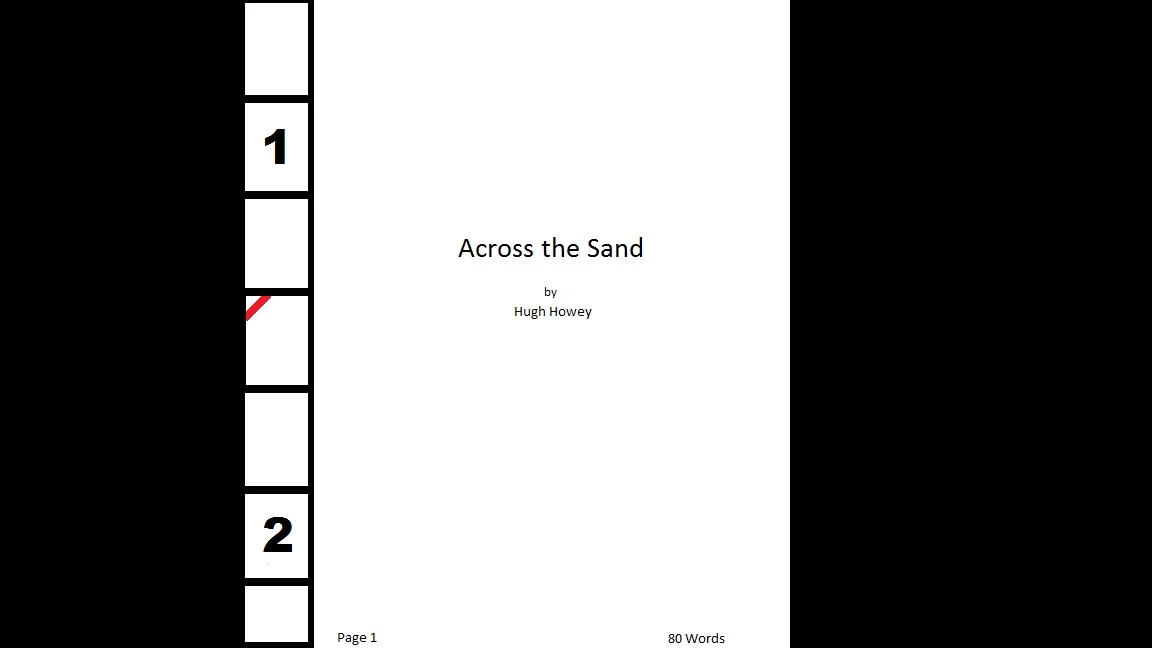
Over the following years, Howey made several attempts to bring NEO to life. He collaborated with a developer while sailing across the Pacific and even pitched a version of the idea to Amazon, hoping authors might eventually write and publish directly through Kindle Direct Publishing. Neither effort produced the application he wanted.
Then, earlier this year, he tried something different. He gave his original specification to Claude. According to Howey’s account, within a few hours he had a buggy but useful prototype. Hundreds of hours of iteration followed as he refined the interface, fixed problems, and added functionality.
In August 2026, he released NEO publicly.
What I find remarkable is that the hardest part of deciding what to build had already happened. Howey had spent years thinking through the details, informed by a career spent writing books. The product vision wasn’t generated by AI. It was his. The technology finally gave him a practical way to implement it.
A word processor that thinks like a novelist
NEO is an interesting application in its own right, even if you’ve never considered writing a novel.
It opens to a bookshelf rather than a conventional file browser. Works in progress appear as books with customizable covers, organized onto shelves however you like. Progress indicators show how close you are to your word-count goals.
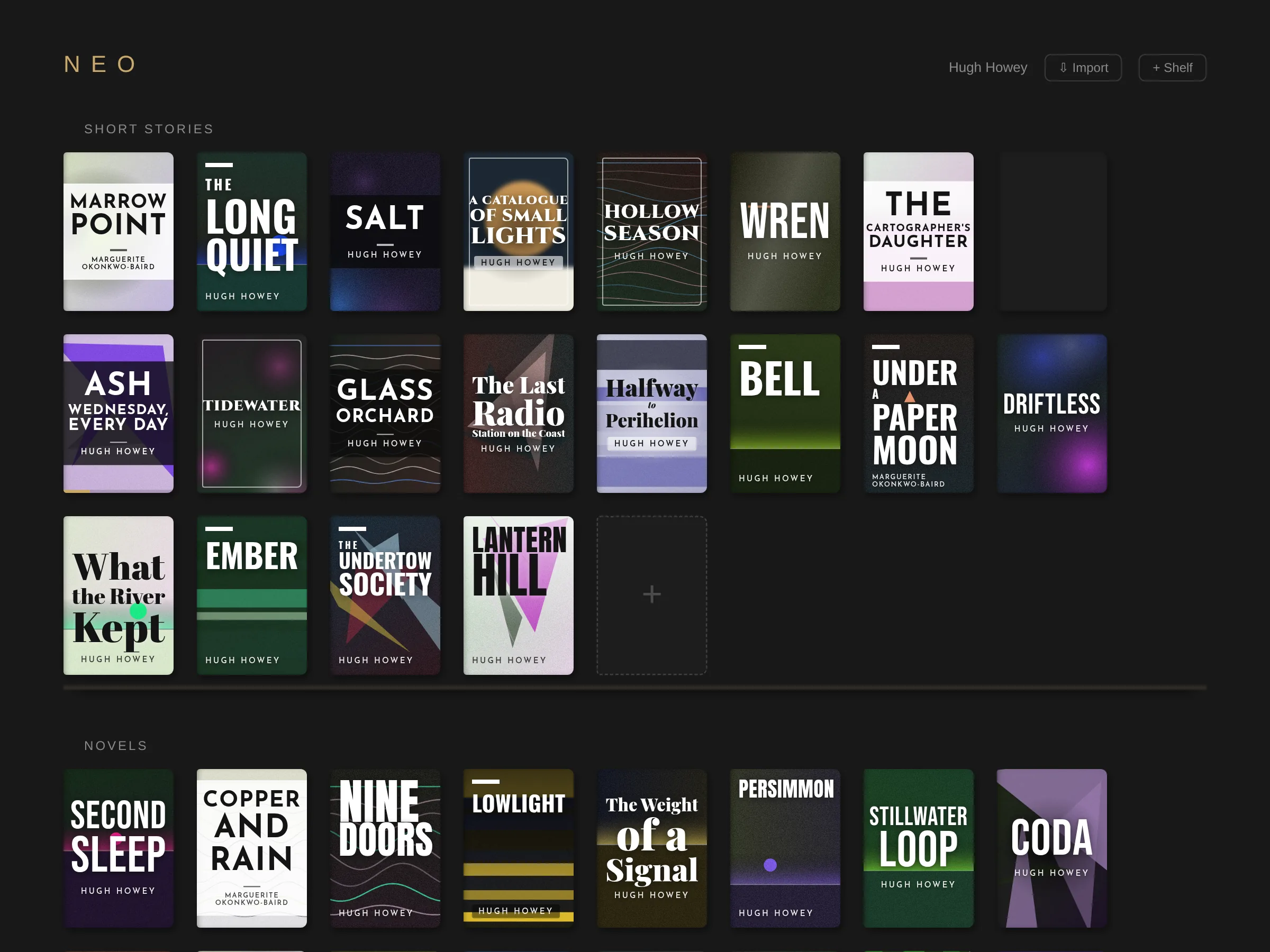
Works in progress look like books instead of another collection of documents. Screenshot: NEO project.
Inside the editor, most controls disappear until you need them. Even spellcheck stays out of the way until explicitly invoked. The idea is to eliminate the little interruptions that accumulate when writing something as substantial as a novel.
Here are a few of NEO’s most interesting features:
Enter, Enter, Enter. One press starts a paragraph, two create a section break, and three start a new chapter. NEO automatically handles formatting and numbering, including when chapters are rearranged later.
Darlings. Writers are often told to “kill your darlings,” removing passages they love when those passages aren’t helping the story. NEO lets you move discarded text into a holding area without permanently deleting it. You can even restore a passage to its original location.
Placeholders. Can’t remember a character’s name or need to verify some historical detail? Drop a marker into the manuscript, attach a note, and keep writing. NEO collects those unresolved details for later so you don’t have to stop and disappear down a research rabbit hole.
There are also draggable index cards for outlining, daily writing goals, timed sprints, and a particularly restrictive distraction-free mode called Enter the Silo. NEO has even expanded into screenwriting, with automatic dialogue formatting and exports compatible with Fountain and Final Draft.
These are the kinds of details that come from spending thousands of hours doing the work. A talented software developer could certainly build these features. But knowing which ones matter, how they should behave, and which seemingly useful additions would only get in the way requires a different kind of expertise.
That’s where Howey has a substantial advantage. He’s designing software around problems he’s experienced personally for years.
Open source, and still evolving
NEO’s source code is available on GitHub under the MIT license, with installers for macOS, Windows, and Linux. There’s no subscription or account requirement. Manuscripts are stored locally as ordinary HTML and JSON files, with continuous saving and daily backups. You can export to EPUB, Word, PDF, Markdown, and other common formats.
Of course, NEO is still young software. Importing existing manuscripts can require cleanup, the mobile companion applications are experimental, and synchronization relies on tools like iCloud or Syncthing rather than a dedicated service.
More people building better tools
What makes Howey’s story especially compelling is the depth of experience he’s bringing to the process. He wasn’t experimenting with a random app idea or looking for an interesting technical challenge. He was building something he’d wanted throughout his career.
Some of the most useful tools are probably ideas that have been sitting in the heads of teachers, scientists, mechanics, artists, and other specialists for years. People who know exactly what’s frustrating about their work, and have imagined better ways of doing it, but never had the time, resources, or programming skills to build those solutions.
And many of those ideas might never make sense as commercial products. The problems might be too specialized, or the potential audience too small. That doesn’t make them any less useful.
NEO is a great example of what can happen when someone with deep domain expertise gains the ability to act on it. And by releasing it as open source, Howey has made something he built for himself available to everyone else.
Nine years ago, he imagined a writing application that didn’t exist. Now it does. That’s pretty awesome.
Check it out: NEO website · GitHub repository · Download NEO