Pen Pals #3: In Search of the Perfect Pocket Notebook
Comparing paper, pocketability, leather covers, and small conveniences to find a good place to start.
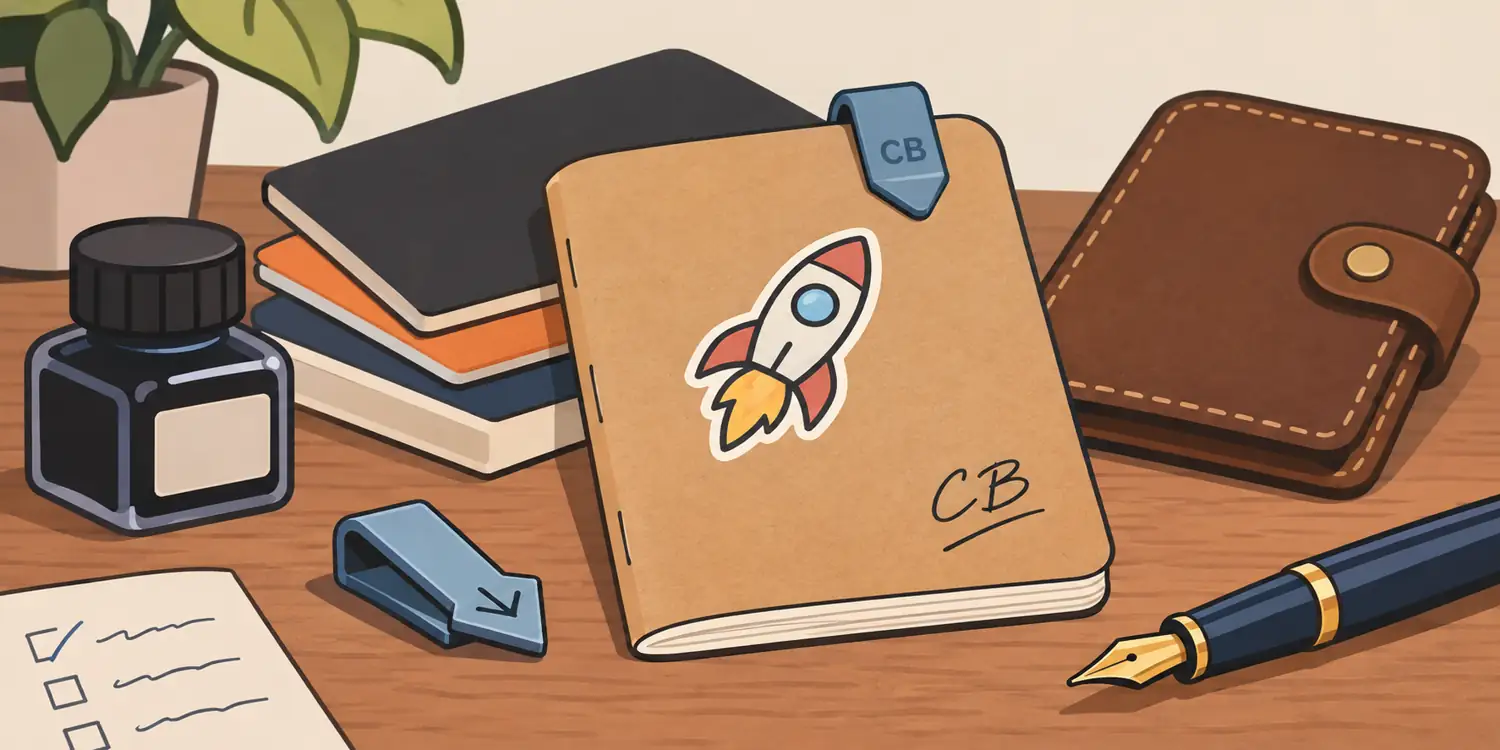
There are few things that should be simpler than buying a little notebook. It’s paper bound together, small enough to fit in a pocket, and useful for writing things down before they disappear from your brain. I’ve used pocket notebooks on and off for years, but with my renewed interest in pens and writing, I decided it was time to take a more deliberate look at what I was carrying. That simple goal eventually led me through specialty stationery shops, leatherworkers, Reddit discussions, and an unreasonable number of browser tabs.
I wasn’t starting entirely from scratch. I had some experience with pocket notebooks, so I knew what I liked about them and what tended to bother me. But I didn’t want to limit myself to a particular brand or assume that what I’d used before was necessarily the best option. I wanted to figure out which features actually mattered to me, explore what was available, and find a good place to start.
What makes a good pocket notebook?
My requirements were pretty straightforward, at least initially. The notebook needed to fit comfortably in my back pocket, which meant it had to be relatively thin and flexible. Hardcover notebooks were out. Sitting on a rigid little book all day is about as comfortable as it sounds, and I wanted something that would conform to my pocket rather than remind me of its presence every time I sat down.
I also wanted something reasonably durable. Pocket notebooks get abused, and between being shoved into pockets, tossed onto tables, and carried around all day, their covers tend to take a beating. A little texture would be nice, both for grip and to keep the notebook from sliding around. I wanted some way to mark my place, too, preferably without adding much bulk.
Another requirement was the ability to tear out pages cleanly. Sometimes I want to keep a note indefinitely, but other times I’m writing a shopping list, a quick reminder, or something I might need to hand to someone else. Perforated pages seemed like a sensible feature for something intended to be carried everywhere.
Then there was the paper itself. As I’ve been exploring fountain pens, I’ve learned that paper quality can make an enormous difference in the writing experience. A good notebook should ideally resist feathering and bleed-through, and behave reasonably well with wetter inks. As a left-handed writer, I’m already navigating enough complications with pens and ink without adding poor paper to the mix.
So the list was simple enough: pocketable, flexible, durable, grippy, easy to navigate, with removable pages and fountain-pen-friendly paper. I figured finding something that met those requirements couldn’t be too difficult.
Sorting through the options
I started with some of the more recognizable notebook brands. Field Notes was an obvious contender, particularly because its standard 3.5-by-5.5-inch format is practically synonymous with pocket notebooks. From there, I investigated Leuchtturm1917, Rhodia, Midori, Stalogy, and a variety of smaller manufacturers.
What surprised me was how differently these companies approached what is fundamentally the same product. Some prioritized exceptional paper, while others focused on durability, binding, or organizational features. There were plenty of appealing options, but each seemed to involve giving up something I wanted.
Here’s how some of the leading candidates compared:
| Notebook | Size | Paper weight | Perforated pages | Biggest trade-off |
|---|---|---|---|---|
| Moleskine Pocket Cahier | 3.5 × 5.5” | 70 gsm | Last 16 sheets | Thin paper with inconsistent fountain pen performance |
| Field Notes Original Kraft | 3.5 × 5.5” | ~90 gsm | No | Excellent pocket format, but no clean tear-out pages |
| Leuchtturm1917 Softcover Pocket | 3.5 × 5.9” | 80 gsm | 8 sheets | More features, but taller and more substantial |
| Rhodia Unlimited | 3.5 × 5.5” | 80 gsm | Yes | Better fountain pen paper, but thicker with an elastic closure |
| Midori MD A6 | 4.1 × 5.8” | 80 gsm | No | Excellent paper, but larger and thicker |
Dimensions are approximate. Field Notes specifies 60 lb text paper, equivalent to approximately 90 gsm. Paper weight measures mass, not writing quality; heavier paper isn’t necessarily better at handling fountain pen ink.
Midori’s paper was particularly appealing, and Rhodia offered a compelling combination of smooth paper, a flexible cover, and removable pages. Leuchtturm had thoughtful additions like numbered pages and built-in bookmarks. But each introduced additional size, thickness, or complexity that made me question how comfortable it would be for everyday pocket carry.
Field Notes came especially close, and I appreciated that they even make a left-handed version of their Original Kraft notebook. Unfortunately, the standard notebooks lack perforated pages. You can certainly tear a sheet out, but it’s not quite the same experience as removing a neatly perforated page. I even investigated adding perforations myself before realizing that creating an extra chore to compensate for a missing feature was probably a sign that I should keep looking.
The leather detour
At some point, I started wondering whether I was trying to find too many features in a single product. Maybe the better approach was to buy a simple paper notebook and put it inside a nice leather cover. That would provide some extra protection, improve the grip, and potentially give me something that would develop character as it aged.
I already have a larger Moleskine work notebook in a Saddleback Leather cover that I’ve used for years, and I love that setup. The leather is substantial, protective, and has aged beautifully. The idea of replicating that experience in a smaller format was appealing, provided I could avoid making the whole thing too bulky.
What started as a search for a notebook quickly became a search for everything I could put around one. I looked at Hitch & Timber, Popov Leather, Bellroy, Galen Leather, and a variety of independent leatherworkers. I searched Amazon and Etsy, investigated leather grades, and dug through Reddit discussions to see which products people actually liked after carrying them for a while.
I found some beautiful options, including a minimalist Field Notes cover made from Horween Chromexcel leather by an Etsy seller called RobertiLeather. At around $45, it was one of the more tempting options. The design was simple, the leather was excellent, and it looked like something that would age nicely. I came very close to ordering one.
But the longer I looked, the less convinced I became that a leather cover was the right solution. Even minimalist designs added thickness, while many other options included pen loops, card slots, and little pockets that made them more like miniature organizers. I was considering spending $45 or more on an accessory for a notebook that cost a fraction of that, all while insisting that portability was my top priority. The leather was attractive, but I was starting to suspect that it might be solving the wrong problem.
Choosing a starting point
After spending far more time than I intended on this search, I started reconsidering which requirements really mattered. Comfortable pocket carry was essential, as was having removable pages. Everything else was a preference I could potentially work around.
That’s how I decided to start with the Moleskine Pocket Cahier. It’s a simple softcover notebook measuring 3.5 by 5.5 inches, with a flexible cardboard cover, a slim profile, and 16 detachable sheets at the back. There’s no elaborate closure, bulky cover, or extensive organizational system. It’s just a small notebook I can comfortably carry everywhere.
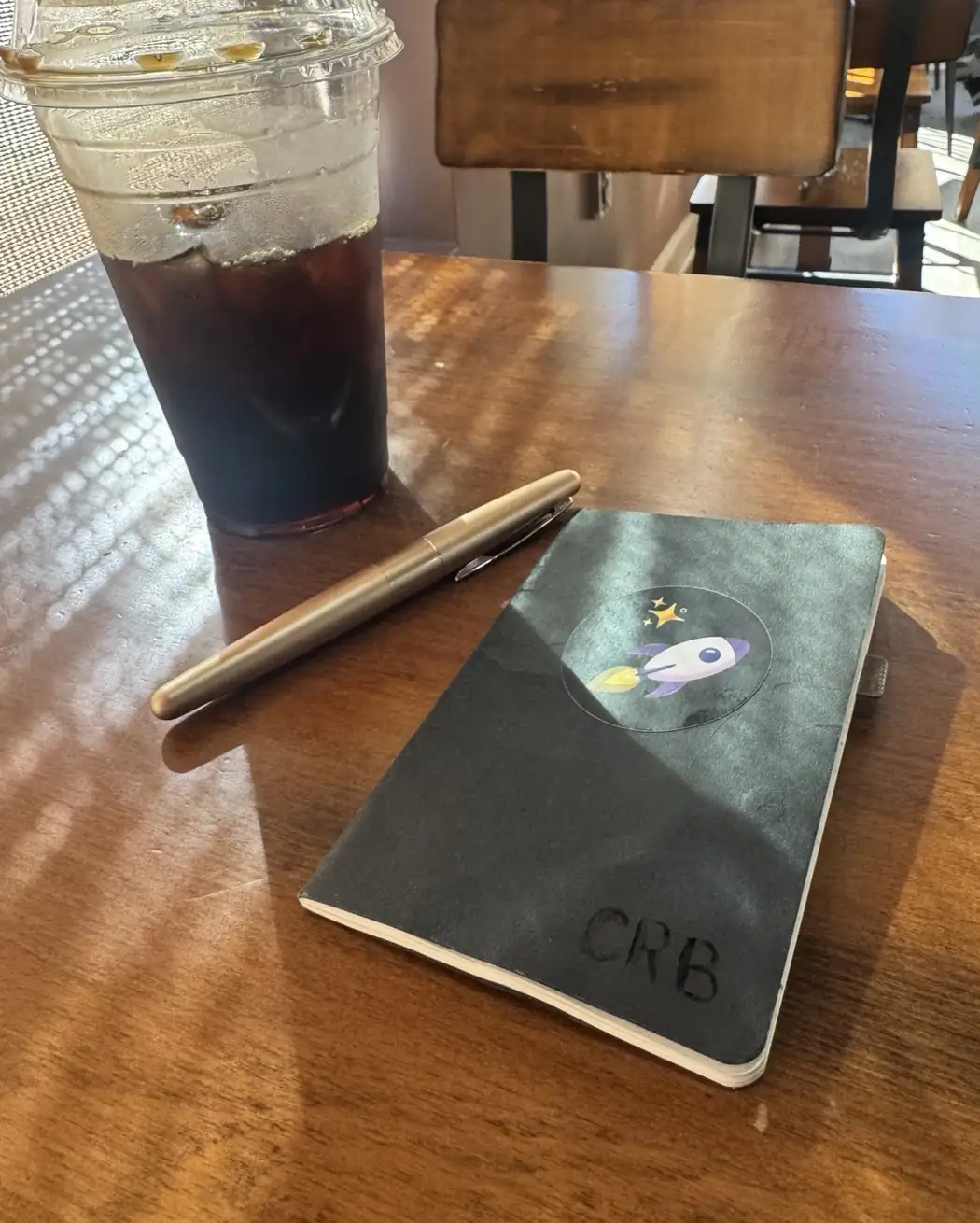
The starting point: a bare Cahier with a little personality, and no added bulk.
There were still two things I wanted to improve: the smooth cover, which offered very little grip, and the lack of a convenient page marker. Fortunately, both turned out to be relatively easy to address.
The solution to the slippery cover was almost comically simple: stickers. I added a little rocket sticker to the front, along with my initials. The stickers provided some texture and gave the notebook a bit of personality without adding appreciable thickness. It was an inexpensive solution that didn’t require buying or maintaining another accessory.
For the bookmark, I turned to my 3D printer. I’d previously printed an arrow-shaped bookmark and line marker from MakerWorld that clips onto a page, and it turned out to work remarkably well. It’s thin, lightweight, and makes finding my place considerably easier without requiring a ribbon or bulky accessory.
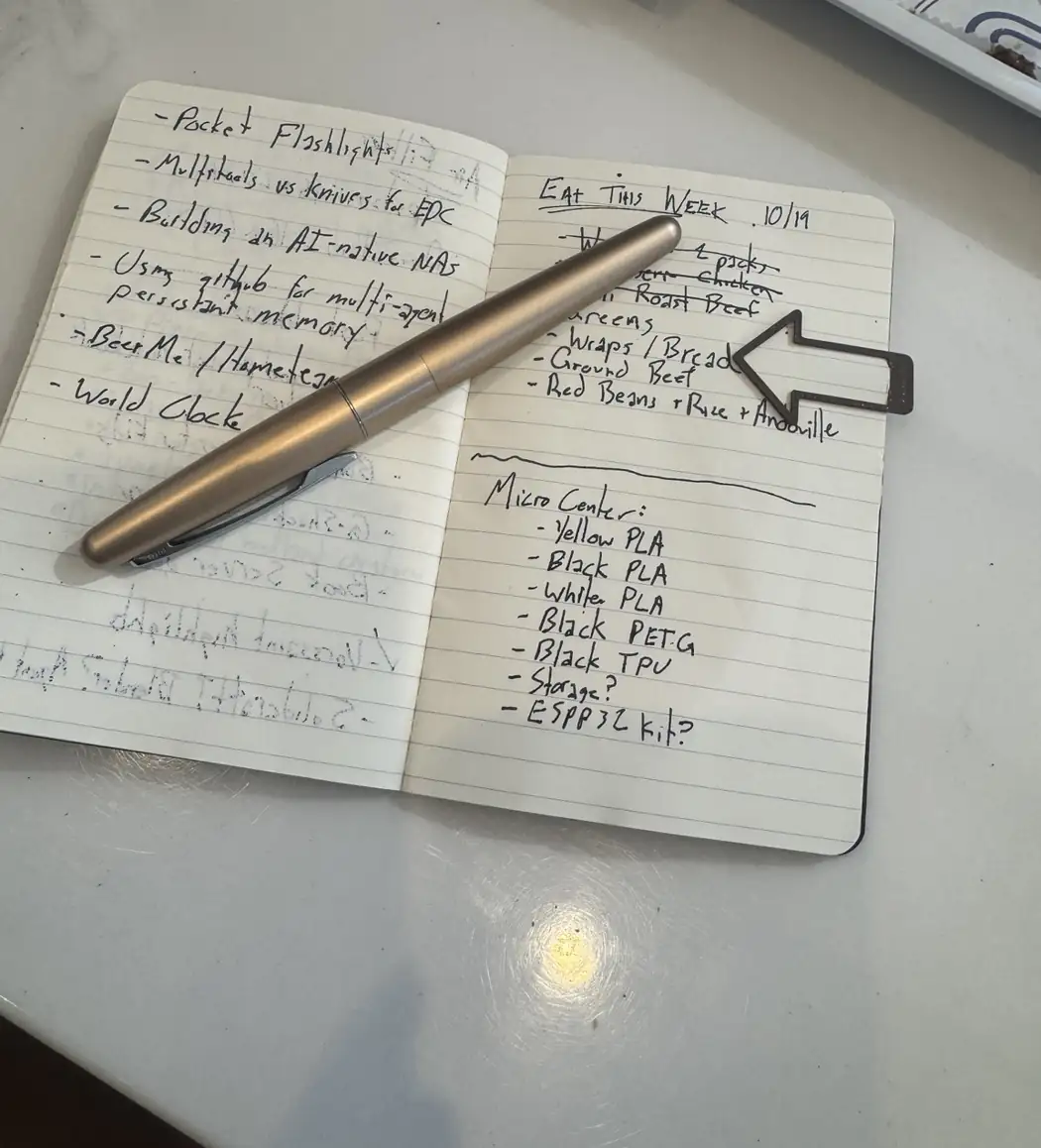
The arrow-shaped bookmark is small, but it’s been one of the more useful additions.
I’ve also started experimenting with my own design. Using SolidCraft, I created a small spring clip specifically for the Cahier, complete with my initials engraved into it. I even published the design and source files on GitHub. I’m still experimenting with that version, but I enjoy the idea of making small, purpose-built accessories rather than buying something that does several things I don’t need.
The result is a simple notebook that feels a little more personal. More importantly, it’s a relatively inexpensive setup that lets me figure out what I actually value through everyday use, without committing to an elaborate collection of accessories.
The paper problem
There’s one significant compromise in this setup, particularly given the direction my Pen Pals adventure has taken me: Moleskine’s paper isn’t especially good for fountain pens.
At 70 gsm, the Cahier’s paper is relatively thin, and depending on the pen and ink, it can suffer from feathering, bleed-through, and substantial show-through. I can already see writing from the other side of the pages in my notebook. It’s not the kind of paper I’d choose if my primary objective were to enjoy the experience of writing with a nice fountain pen.
It’s a slightly strange position to be in, considering how much time I’ve spent lately exploring pens, nibs, and inks. After putting so much effort into finding a writing instrument that performs beautifully, choosing paper that doesn’t necessarily bring out its best qualities seems counterintuitive.
But my pocket notebook serves a different purpose from something I’d use for more deliberate writing. Looking through its pages, I find project ideas, meal planning, reminders, and shopping lists for trips to Micro Center. It’s a place to capture things before I forget them, not somewhere I’m trying to produce beautiful handwriting.
For now, I’m choosing convenience over paper quality. I want something I can pull out quickly, scribble in, and put away without much thought. The notebook needs to be comfortable enough that I actually carry it, and inexpensive enough that I don’t hesitate to use it. If that means tolerating some show-through or less-than-ideal ink performance, it’s a compromise I’m willing to try.
Whether I’ll still feel that way after spending more time with different fountain pens and inks is another question. I may eventually find the paper limitations more frustrating than expected, particularly as I discover better writing experiences elsewhere.
Where to go from here
After comparing notebooks, researching leather covers, and experimenting with a few small modifications, I’m starting with a Moleskine Cahier, a rocket sticker, and a 3D-printed bookmark. It’s not the best notebook in every category, but it gives me a practical baseline and a chance to see which of my priorities hold up in everyday use.
I’m still interested in trying notebooks with better paper, and I haven’t completely abandoned the idea of a nice leather cover. I’m curious whether a different format might eventually offer a better balance of writing quality and portability, or whether I’ll discover that the simplicity of the Cahier matters more to me than I initially appreciated.
For now, I’m more interested in using the notebook than continuing to shop for one. I’ve learned quite a bit about what’s available, but there’s only so much a product description or a Reddit review can tell you. The rest will have to come from actually carrying it, filling its pages, and seeing what I want to change next.