The Game Is the Excuse: What Kids Learn by Designing Video Games
Over the past few weeks, I’ve been working with young family members, ages 6–8, to design their own video games. We’ve made four so far, each based on their own characters, stories, and occasionally ridiculous ideas. I expected the finished games to be the fun part. What caught my attention instead was how much thinking went into designing them.
There’s an educational philosophy called constructionism, associated with MIT researcher Seymour Papert, that focuses on learning through making things that matter to the learner. In a review of 55 studies on children making games, researchers Yasmin Kafai and Quinn Burke examined how game creation can support learning, particularly programming and computational thinking. The studies aren’t a direct test of what we’re doing—our young designers aren’t writing the code themselves—but the broader idea of learning through creation feels familiar.
I wasn’t setting out to run an educational experiment. I just thought it would be fun to help the kids bring their ideas to life. Four games later, I’ve come to appreciate the work that happens before anyone picks up an iPad.
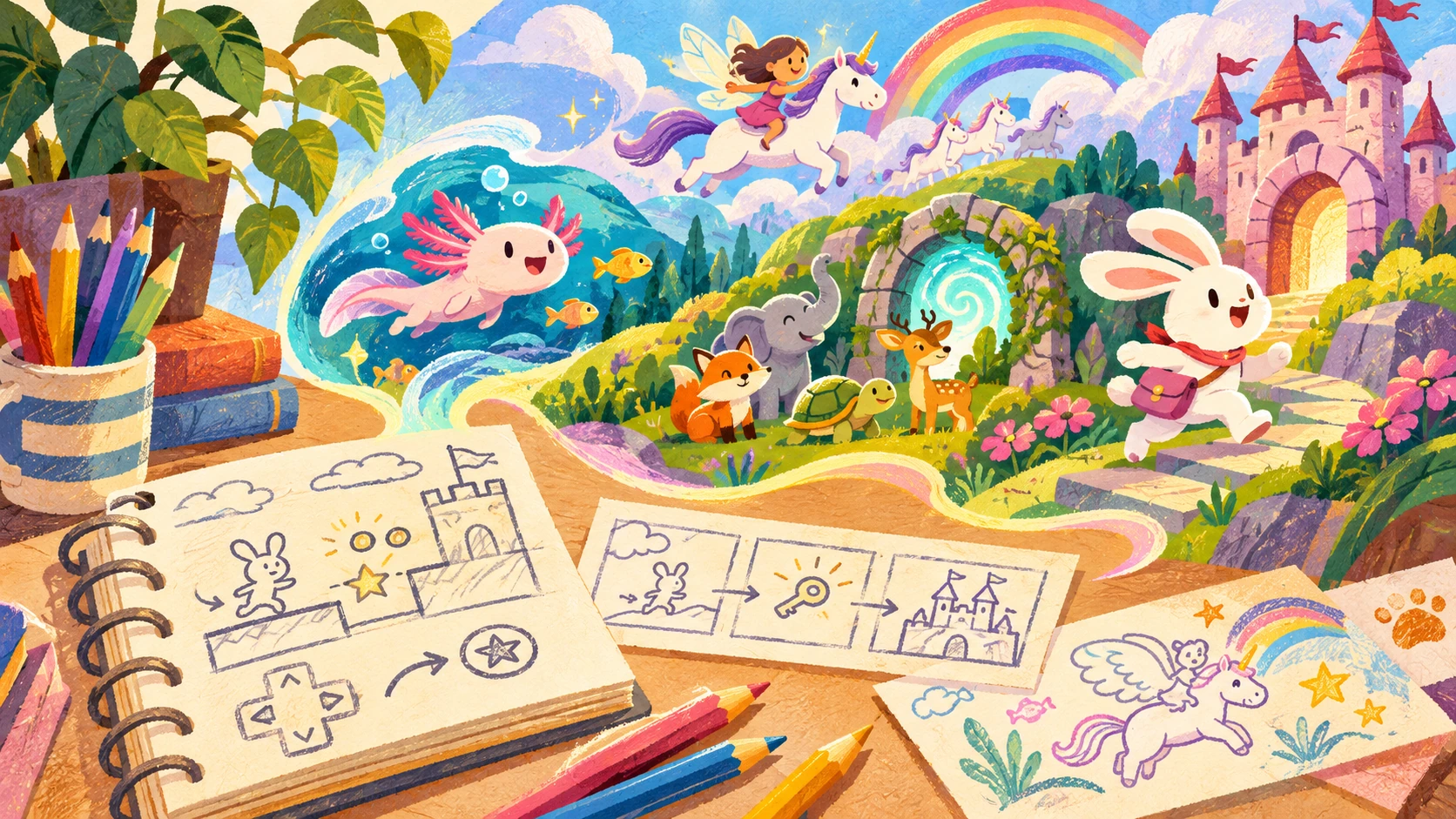
Imagination is easy. Planning takes practice.
If you’ve ever asked a child to invent a story, you probably know how quickly things can get out of hand. There’s a bunny trapped in a castle, a tiger waiting to chase it, a king secretly controlling robot bunnies, a portal inside a rainbow, and a giant monster at the end. All terrific ideas, but not necessarily in that order. Ask what happens first and you might get a completely new character instead.
I didn’t want to slow down that imagination, but I did want to help the kids organize it. We started drawing characters, sketching screens and controls, and writing specifications together. We worked through what the player would do from the beginning of the game to the end: What happens first? What needs to happen before the next level opens? What happens if a player gets stuck? How does the story finish?
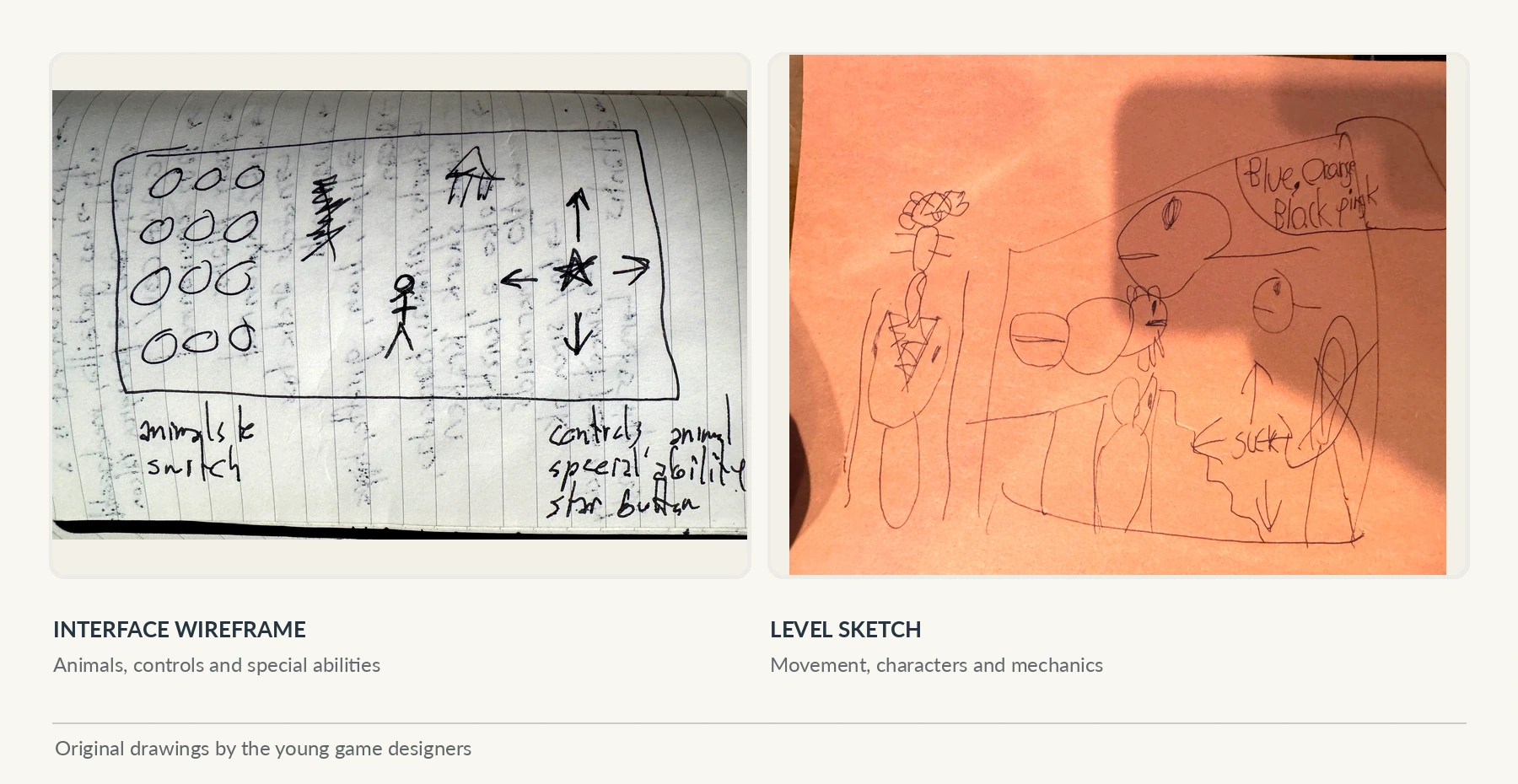 Two of the original drawings we worked from. These aren’t concept art produced after the fact; they’re part of how we decided what to build.
Sometimes we had to move an idea to a different level or revisit an earlier decision. Rather than limiting their creativity, having a structure seemed to give them more to think about. It’s one thing to invent a tiger that chases a bunny. It’s another to decide when the tiger appears, what happens if it catches the bunny, and how the player gets back to the adventure afterward.
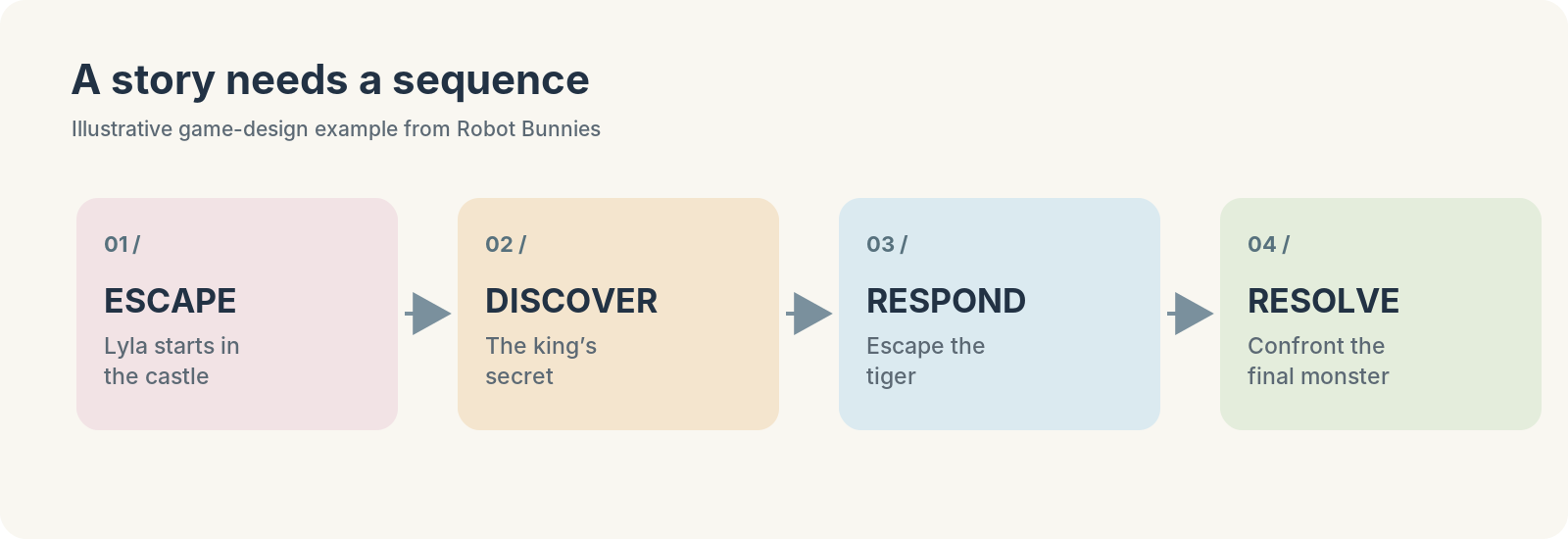 An illustrative sequence from Robot Bunnies. The drawing process pushed us to connect events, not just invent more of them.
I later found a remarkably close parallel in a Harvard Center on the Developing Child guide. It discusses play plans: children decide what they’re going to do, draw the plan, and then follow it during imaginative play. The guide also notes that children’s early stories can be collections of loosely connected events that develop into more organized plots with practice. That’s a pretty good description of what I was seeing, even though our projects involve older kids and digital games rather than classroom pretend play.
A little systems thinking, without the jargon
Another thing the projects introduced was computational thinking. The name sounds like it belongs in a programming class, but a lot of it is simply learning to break a big idea into smaller problems, decide on rules, and consider how things connect. Reading Rockets makes a similar point about sequencing in stories: understanding what happens first, next, and last is useful well beyond reading.
Take Transforminals, a game about rescuing animals and transforming into them. Once that premise was established, we had to answer a lot of questions. Where do the animals live? How are they rescued? What does transforming actually do? Can every animal have its own ability? How do players know what they’ve already found? Each answer affected the rest of the game, which made it difficult to design one feature without thinking about several others.
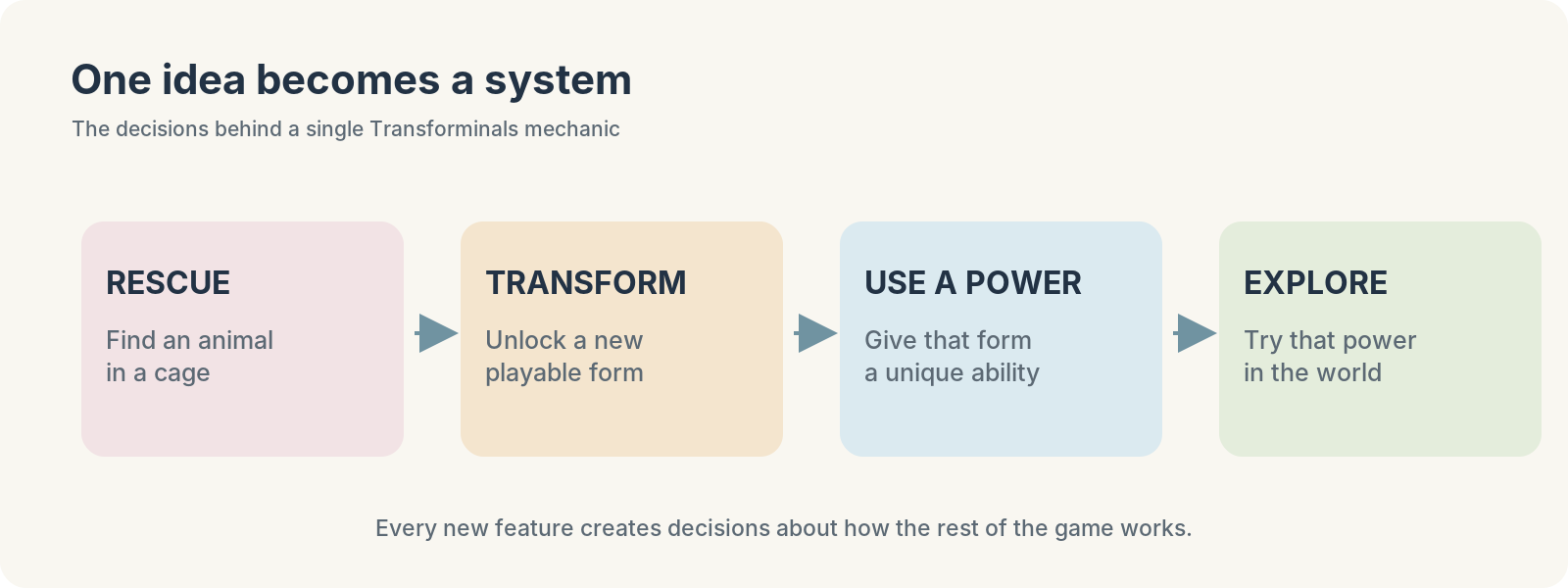 An example of how one creative idea turns into a chain of connected design decisions.
The original control wireframe captures that thinking surprisingly well. It has a place to switch animals, a player in the middle, directional controls, and a separate button for special abilities. It’s not a polished interface, nor was it supposed to be. It’s a child beginning to consider what the player needs on screen and how the game will respond.
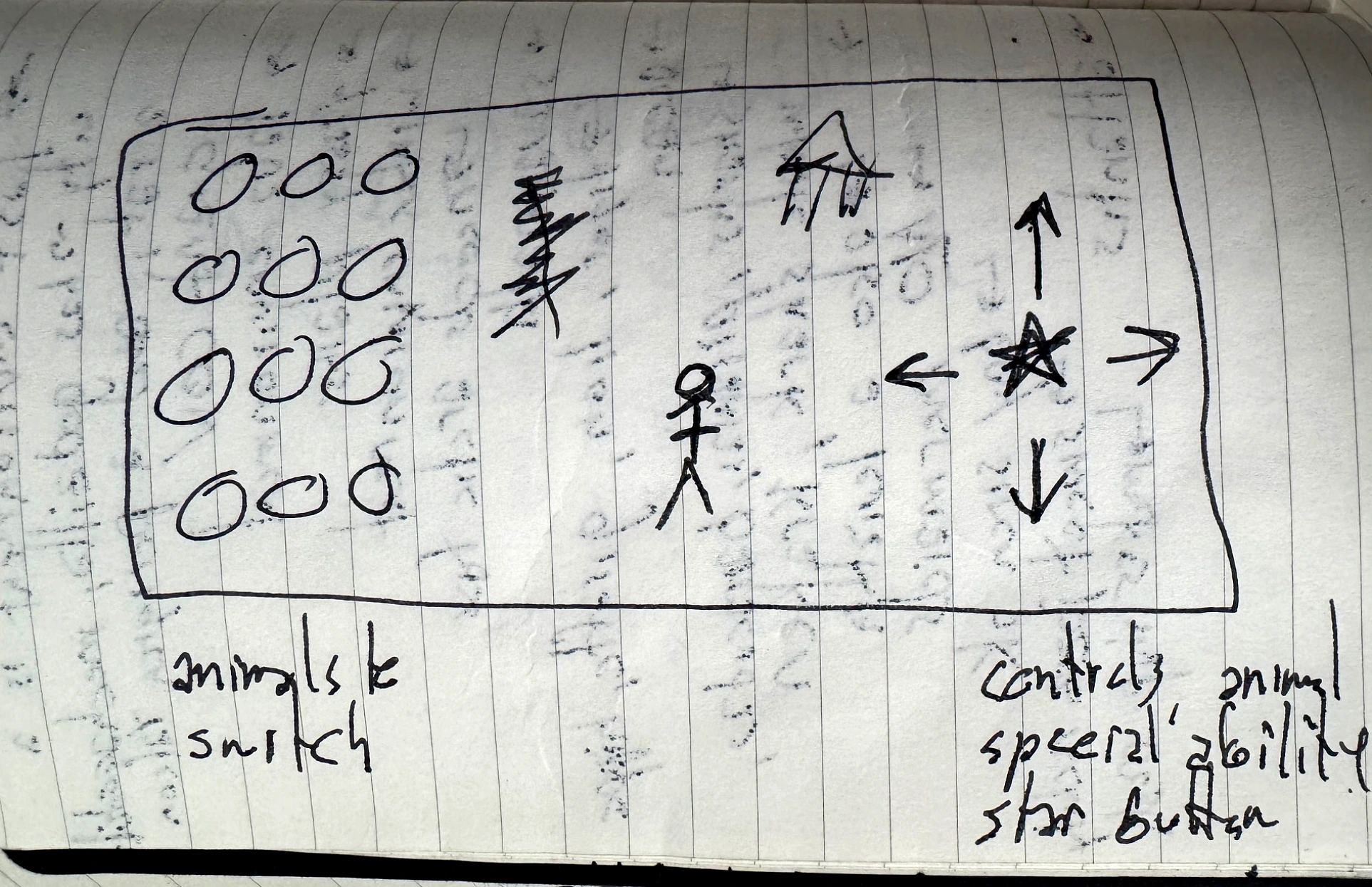 The actual wireframe, lightly cleaned up for readability. The animals, movement controls, and special-ability button were all there from the sketching stage.
There’s a connection here to executive function, too: remembering decisions, keeping a goal in mind, planning steps, and changing course when something doesn’t work. Harvard’s guide describes playful activities as opportunities to practice those skills. I can’t claim we’ve measured any improvement, but I can see the opportunities to practice them every time we work through a design problem. The kids have a reason to stick with it because they’re solving a problem in a world they created.
Four games, four very different ideas
The games themselves are pretty different, which is part of the fun. The common thread has been treating the kids as the designers and creative directors rather than just asking what kind of game they’d like to play.
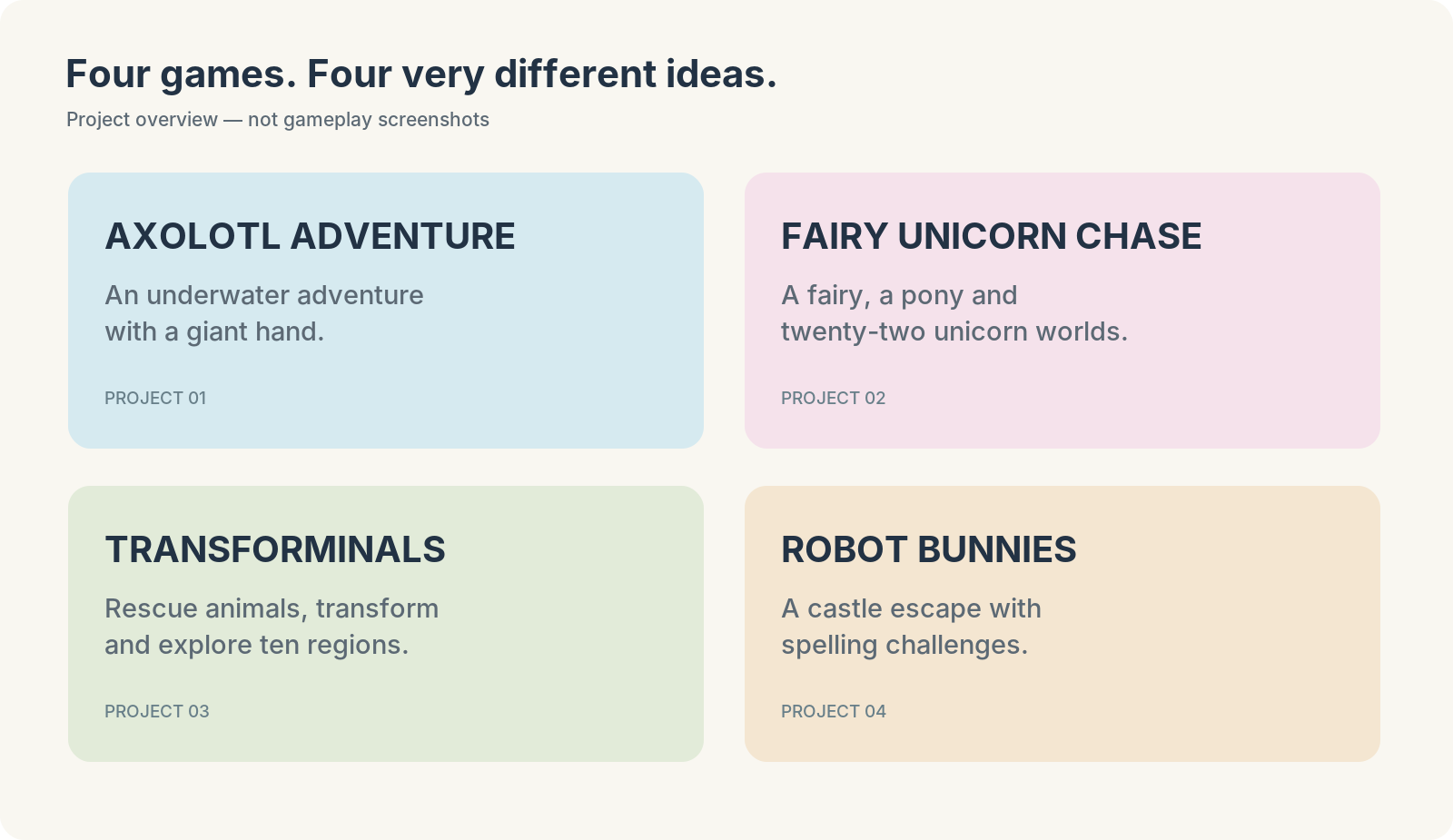 The four projects so far. The variety of ideas has been as interesting as the games themselves.
Axolotl Adventure is a five-level aquarium adventure where an axolotl sucks up fish, avoids dangerous creatures, and eventually battles a giant hand reaching into the tank. There’s also a magic pizza that restores health. I don’t know why there’s pizza underwater, but apparently there needed to be.
Fairy Unicorn Chase follows Mia, a fairy riding a pony named Glender, through 22 magical worlds collecting unicorn friends. Alongside the characters and scenery, we had to work through how to make the game approachable: simple controls, forgiving obstacles, and enough variety to keep the chase interesting without making it frustrating.
Transforminals is a much larger adventure with ten environments, 22 animals to rescue, playable transformations, special powers, and a final demon lizard. Keeping track of how those pieces fit together became a design challenge of its own.
Robot Bunnies: Lyla’s Spelling Quest is a 22-level adventure featuring a bunny named Lyla, an evil king, and robot bunnies controlled by his phone. It also became our first experiment in incorporating schoolwork into a game the child had already imagined.
The games run in a browser and are designed for iPads, although some still need more testing on the devices themselves. We wrote specs, drew the wireframes, and guided the mechanics together. Codex and Claude Code handled the coding and turned those designs into playable games. That let the kids concentrate on the decisions that mattered to them, rather than the programming needed to implement those decisions.
Making the schoolwork part of the adventure
Robot Bunnies was a chance to try something a little different. One of the young designers has weekly spelling tests, which aren’t always the most appealing thing to practice. Instead of making a separate educational game and hoping it would be interesting enough, I looked for a way to put spelling into the adventure that was already taking shape.
At certain story moments, the action pauses and the player hears a word from the actual school list. They arrange letter tiles to spell it from memory, get feedback, and then continue the adventure. Words that need more practice can come back later, and progress is tracked on the device.
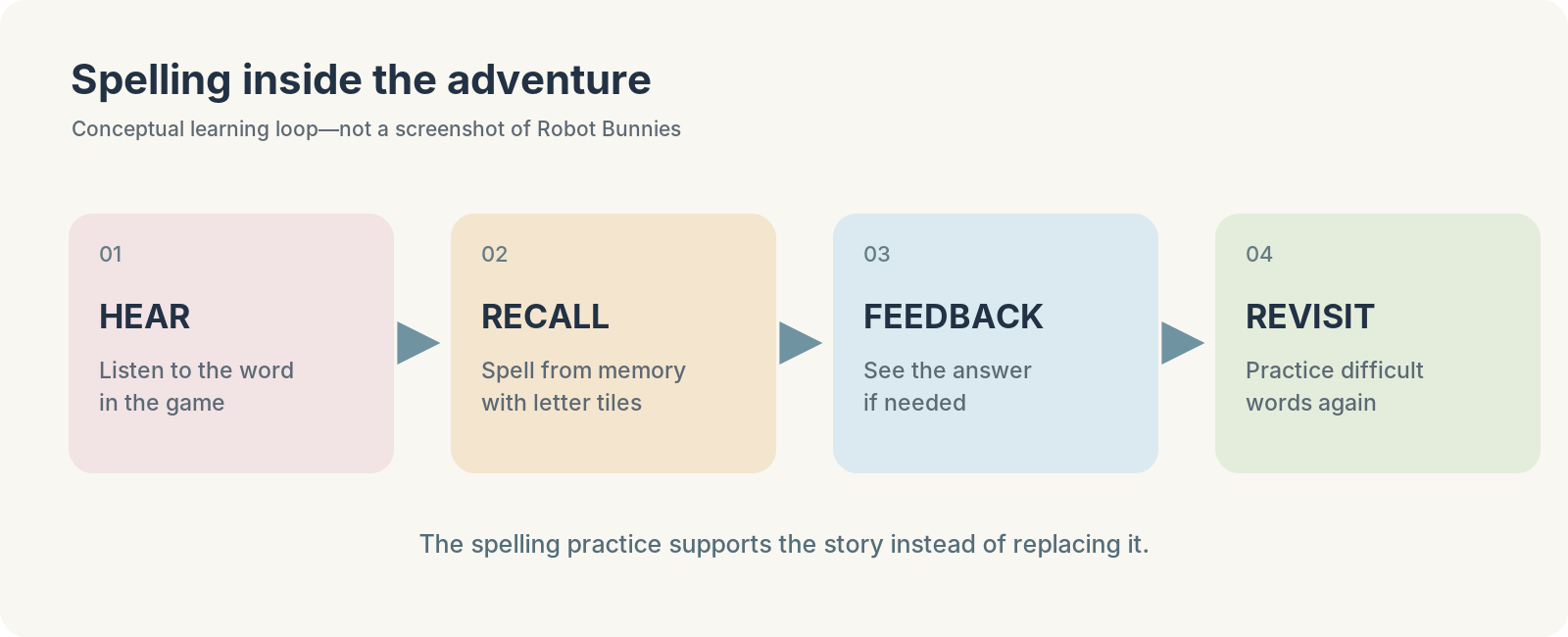 The educational mechanic is built around remembering the word, not copying it from the screen.
That design choice came from a 2016 study of first- and second-graders that compared spelling practice through retrieval from memory with repeatedly writing words in different colors, sometimes called rainbow writing. Across three small experiments, students performed better after retrieval practice. The game uses letter tiles rather than handwriting, so I wouldn’t assume the results transfer perfectly, but the findings gave me a useful direction for the practice mechanic.
I don’t yet know whether the game will improve spelling scores, and it’s not a substitute for instruction or writing practice. What interests me is the ownership. We didn’t start with a spelling app and add a few cartoon characters to make it palatable. We started with a game the child wanted to make, then found a way to practice something useful while playing it. The goal is still to help Lyla get through the adventure; spelling just becomes part of how that happens.
A working game isn’t the end of the design
Once a first version was playable, the kids had an entirely new set of opinions. An obstacle was harder than expected, a character needed a different ability, or an area wasn’t quite what they pictured. We could compare the result with the sketches and specifications, talk about what wasn’t working, and change it.
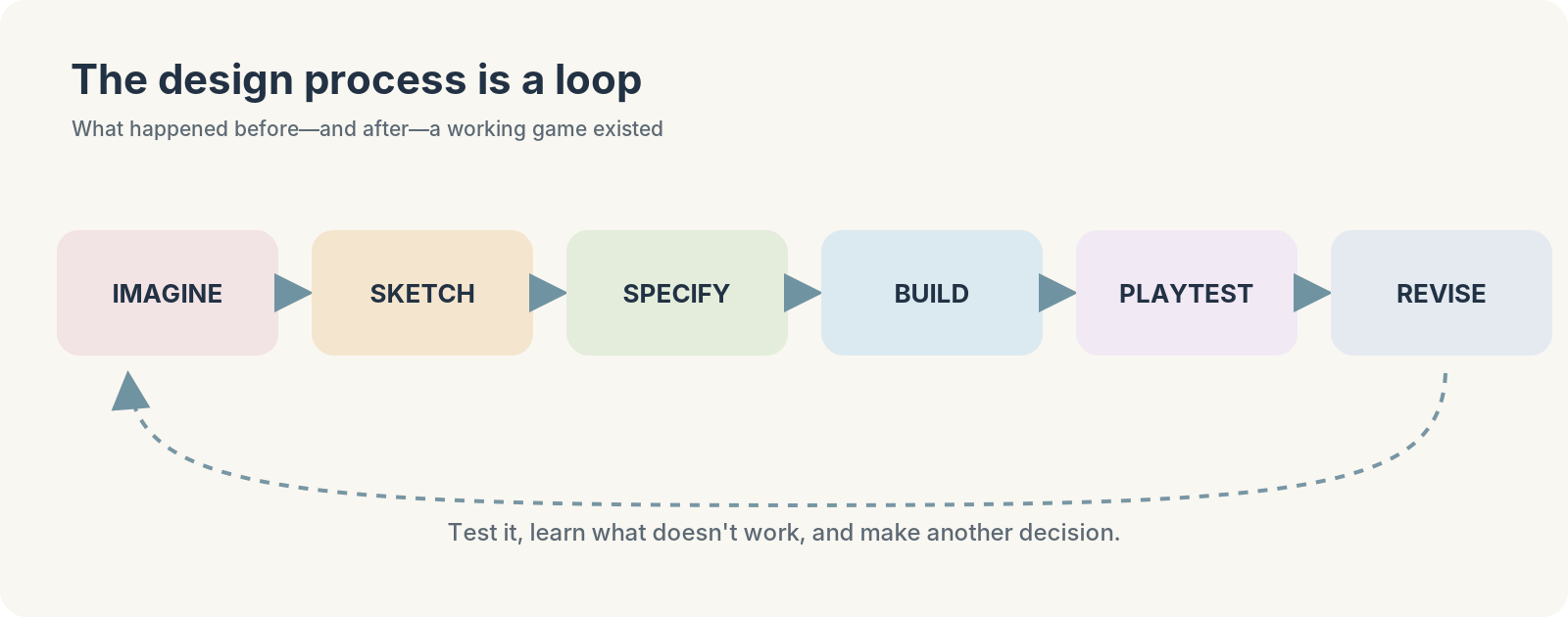 What our projects actually looked like: less a straight line from idea to finished game, more a loop of testing and revising.
That process reminds me of Mitchel Resnick’s creative learning work at MIT, which emphasizes projects, personal interest, collaboration, and playful experimentation. The useful lesson wasn’t that the first idea should be perfect. It was that making something means trying an idea, seeing how it works, and being willing to improve it.
I also had to be careful not to do too much of that thinking for them. It’s easy for an adult to fill in the blanks when a child’s explanation doesn’t quite make sense, and a coding assistant can do the same thing. Often the better move was to ask another question and give the child a chance to decide. That might take longer, but the decision-making is the point.
The game is the excuse
I’m not suggesting game design can replace formal education, or that more screen time is inherently better. A lot of what I’ve enjoyed about these projects happened with pencils, paper, and conversations before the games were playable. The finished products are fun, but the more interesting part has been watching the kids turn a collection of imaginative ideas into something coherent enough for someone else to build and play.
I started these projects because I thought the kids would enjoy having games of their own. They do, but I’ve found the process of making them just as rewarding: planning a story, thinking through a set of rules, changing a design when it doesn’t work, and seeing those decisions take shape. The games are a pretty good excuse to practice all of that.