What's the Difference Between a Chatbot and an AI Agent?

You’ve probably used ChatGPT. But what does it mean when AI starts doing things for you instead of just answering questions?
I’ve been talking to people about AI agents lately, and I’ve noticed a recurring point of confusion. Plenty of people are already comfortable using ChatGPT, Claude, or Gemini, but aren’t quite sure what makes an AI agent different. Aren’t these all just different names for the same thing?
I understand the confusion. I use ChatGPT constantly for researching purchases, troubleshooting problems, writing code, and working through ideas. It’s become one of those tools I wonder how I managed without, and I suspect plenty of other people feel the same way.
Over the past several months, though, I’ve also been experimenting with personal AI assistants, particularly Meta’s Muse. I’ve found that there’s quite a difference between having an AI that helps me figure something out and having one that can actually take care of it. And as these assistants become more capable, that distinction is getting considerably more interesting.
The work that’s left after the answer
Let’s say you want to lower your internet bill. ChatGPT can research competing offers, suggest negotiation strategies, and write a convincing script for customer service. That’s useful, especially if you don’t particularly enjoy negotiating. Unfortunately, you still have to do the negotiating.
Recently, I tried a different approach. My Xfinity bill was $113 per month, and I wanted a better deal. I asked Muse to handle it, with two conditions: don’t reduce my internet speed, and don’t sign me up for any additional services.
Muse navigated Xfinity’s website, connected with a customer service representative, and negotiated on my behalf. When the representative proposed a cheaper plan that would have reduced my speed, Muse pushed back. Eventually, the representative offered a $20 monthly discount for twelve months, keeping my existing service intact.
I reviewed the terms, completed the required consent form, and the representative confirmed the agreement. My account page hadn’t immediately reflected the discount, so I still needed to verify the result. I’m not quite ready to take an AI’s word that something is finished without checking.
Still, I’d avoided dealing with Xfinity customer service myself, which felt like a pretty good outcome. The difference wasn’t that Muse necessarily knew more about negotiating than ChatGPT. It was that Muse could actually carry out the negotiation, including the back-and-forth that would otherwise have required my attention.
I’ve since used agents for other mundane tasks, from adding appointments to my calendar to navigating government paperwork. I wrote about 20 things I’ve used Meta Muse to do in an earlier post, if you’re curious. None of these tasks is particularly extraordinary, but getting them off my plate has been surprisingly satisfying.
So what exactly is an agent?
The terminology is a bit of a mess. Chatbots, AI assistants, agents, agentic AI, autonomous agents. You’ll hear these terms used interchangeably, sometimes by the companies building the products themselves.
A chatbot is primarily built around conversation. You ask it a question, give it instructions, or work through a problem together. Modern chatbots can already search the internet, analyze documents, write code, and use connected services, so they’re capable of quite a lot.
An AI agent goes a step further by pursuing a goal and figuring out which actions are needed to accomplish it. That might mean navigating websites, filling out forms, interacting with other software, or adjusting its approach when something doesn’t work. Rather than directing every step, you give it an objective and let it work through the process.
The distinction isn’t necessarily about which product you’re using. ChatGPT itself has agentic capabilities, and other familiar AI tools are moving in the same direction. It’s probably more useful to think of agentic as a way AI can operate rather than an entirely separate kind of technology.
An agent doesn’t need to work without supervision, either. I can give one a task and let it handle the tedious parts while still requiring approval before it spends money, sends a message, or commits me to something. That’s an arrangement I’m much more comfortable with than giving it completely free rein.
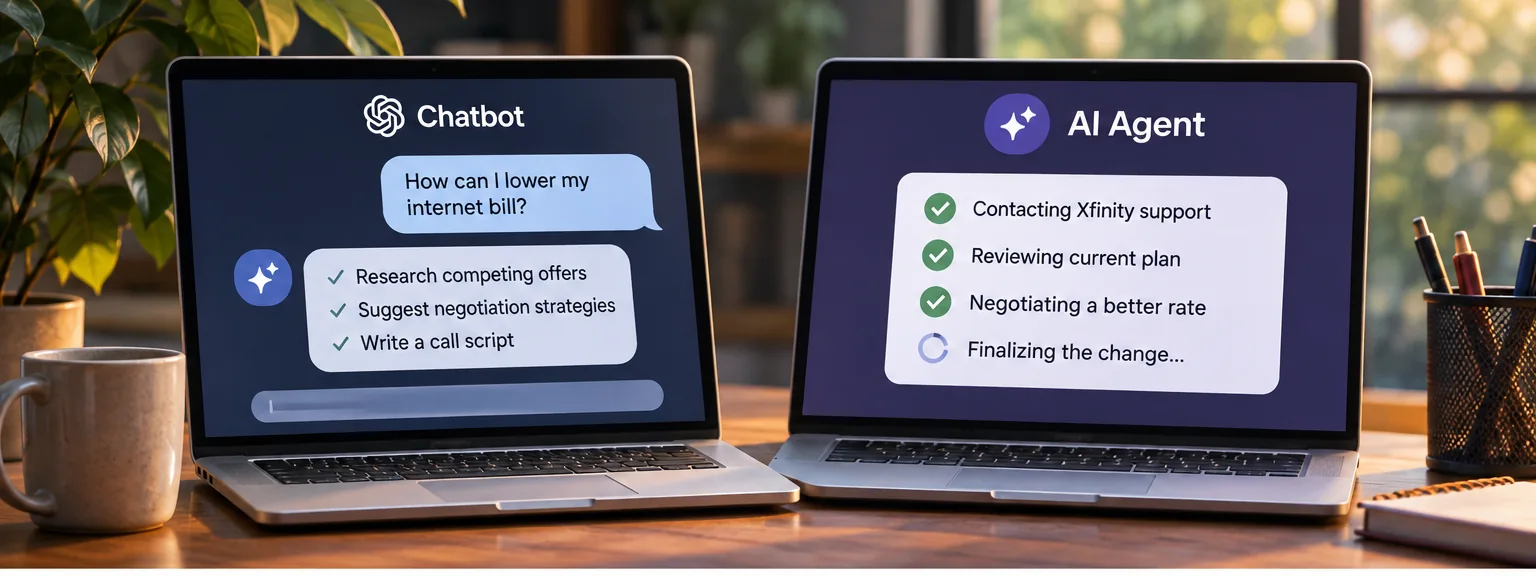
An illustrative comparison: the chatbot suggests what to do, while the agent works through the steps.
When the assistant doesn’t wait to be asked
Completing a task is useful, but I’ve become particularly interested in two other capabilities emerging in personal AI assistants: proactivity and reflection.
Most of us are accustomed to initiating every interaction with AI. We open ChatGPT, ask a question, get an answer, and move on. A proactive assistant changes that arrangement by keeping track of ongoing responsibilities and bringing things to our attention when they’re relevant.
I live in Alexandria, Virginia, and I enjoy keeping up with development around my neighborhood. Rather than remembering to research the same properties every week, I’ve set up a recurring task in ChatGPT that checks for development news, permits, leasing activity, and other updates every Friday.
We’ve had scheduled reminders and automatic alerts for decades, of course. What’s interesting is combining those capabilities with AI that can investigate multiple sources, interpret what it finds, and help identify whether anything meaningful has changed.
More sophisticated assistants are beginning to take this further, using their understanding of your interests and responsibilities to decide what deserves your attention. Perhaps it’s a scheduling conflict, a price drop on something you’ve been considering, or an update to a topic you’ve been following.
The challenge is figuring out what’s actually useful. I don’t want an assistant interrupting me every time it finds something vaguely related to my interests. One that understands what matters to me, and when something is worth mentioning, would be much more valuable.
That’s where reflection comes in.
Most people are familiar with AI memory by now. ChatGPT might remember your preferences, your occupation, or something you discussed a few weeks ago. Reflection takes that idea further by allowing an assistant to review previous interactions, consider what worked, and adjust how it approaches future tasks.
My Xfinity negotiation provides a simple example of why that context matters. Muse retained my requirements about preserving internet speed and avoiding bundles, and applied them when the representative proposed something that didn’t meet those conditions. Afterward, it set a reminder for September 2027, ahead of the discount’s expiration, carrying those same requirements forward.
That’s persistent memory in action. A more reflective assistant could also examine how the negotiation went, identify what was effective, and use that experience when approaching the next one. Rather than configuring every preference in advance, you could gradually establish a working relationship through ordinary interactions and feedback.
I find that possibility particularly interesting, although there’s a difference between an assistant claiming to learn and actually demonstrating improvement. These systems can misremember details, draw incorrect conclusions, or repeat mistakes. Reflection also doesn’t necessarily mean the underlying AI model is retraining itself; often it’s a matter of reviewing stored information and applying it more effectively.
Still, the combination of taking action, showing initiative, and learning from experience is a considerably more ambitious goal than simply giving a chatbot access to a web browser.
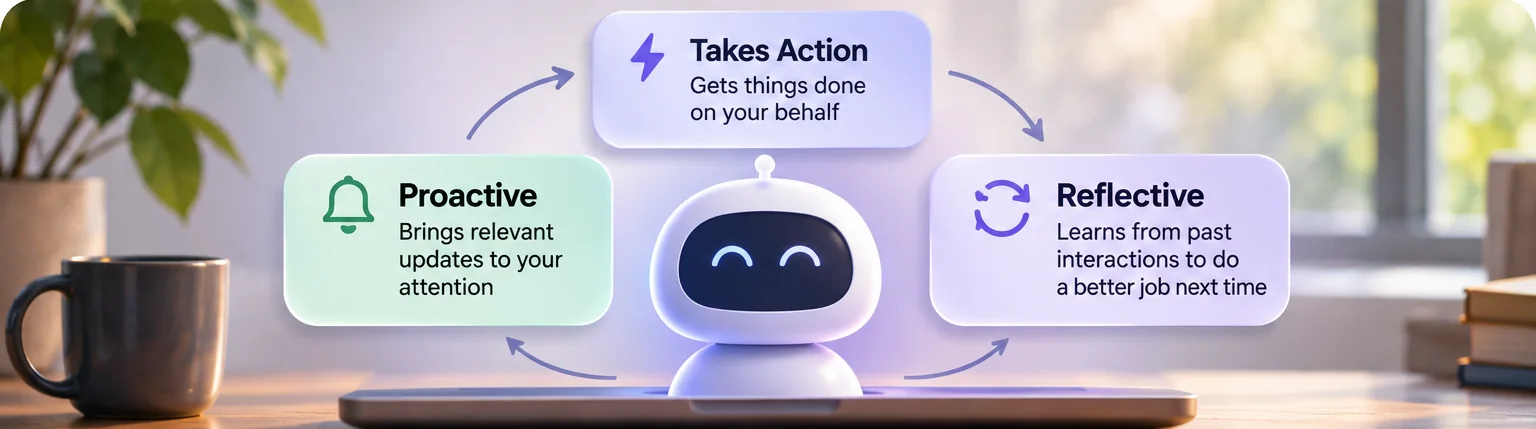
The combination of action, proactivity, and reflection is what makes persistent assistants interesting.
A look at the personal AI assistant landscape
Several companies are now building assistants around these ideas. Some focus on everyday errands, while others are designed to manage ongoing projects or work alongside you throughout the day.
Here are four I’ve been following, each taking a somewhat different approach.
| Assistant | What I find interesting | Limitations |
|---|---|---|
| Meta Muse | Everyday personal tasks, ongoing monitoring, and persistent memory. Offers a free tier, and I’ve found it approachable. | Usage limits, occasional website and login difficulties, and the privacy considerations of sharing information with Meta. |
| OpenAI Dots | Proactive work built around ChatGPT’s existing memory, connected applications, and user context. Particularly interesting if you’ve used ChatGPT extensively. | Limited rollout, with availability dependent on eligibility. |
| Grok Bot | Persistent agents that can collaborate and operate in cloud computing environments. An interesting approach to handling multiple responsibilities. | Paid plans, usage limits, and shared computing environments that require care with account access. |
| Claude Duet | Proactive assistance and professional workflows, building on Claude’s existing capabilities and connected services. | Still a limited research preview, with capabilities that are continuing to develop. |
This is a snapshot of the landscape as of November 2026. Features, pricing, and availability are changing quickly.
Muse is the one I’ve spent the most time using, so I can’t offer a firsthand comparison of all four. I’m particularly curious about Dots and Duet because they build on AI products people already use. There’s something appealing about an assistant that can make use of the context you’ve accumulated through months or years of conversations.
I’m also interested in how different these approaches might become. Some companies seem focused on building a personal assistant for everyday life, while others are leaning toward digital coworkers that manage more involved projects. I suspect we’ll see plenty of overlap as these products develop.
What about privacy and security?
This is probably the most common concern I hear when discussing AI agents, and I think it’s a reasonable one. An AI that answers questions is one thing. An assistant that can access your email, calendar, files, and personal accounts, while retaining information about you over time, introduces a different set of considerations.
I’ve tried to be deliberate about how much access I give my assistants. They have their own email addresses and calendars, and can copy me on messages or invite me to appointments rather than operating directly through my primary accounts. I also require approval before they send messages or make commitments on my behalf.
They use separate browser environments, too, including one running on a Raspberry Pi on my home network. I’ve written about that setup separately for anyone interested in the technical details. I think of it a little like giving an assistant its own office, phone number, and set of keys rather than handing over mine.
None of this is foolproof. Separate accounts don’t eliminate the risks of sharing information with an AI provider, and agents can still make mistakes or encounter malicious instructions. Persistent memory and proactive monitoring introduce additional questions about what information is retained and how much independence you’re comfortable granting.
My approach is to start with limited access and expand an assistant’s responsibilities as I become more comfortable with it. There are things I’m happy to delegate and things I’m not, and I suspect everyone will draw that line a little differently.
Finding the right balance
Despite all this experimentation, I still spend plenty of time simply talking to ChatGPT. If I’m trying to understand a book I’m reading, work through an idea, or explore a complicated topic, I don’t need an agent navigating websites on my behalf. I’m looking for a conversation, not someone to take over the task.
Agents aren’t always the more efficient option, either. They get stuck, misunderstand instructions, and occasionally announce they’ve completed something that remains very much unfinished. I’ve had situations where supervising an assistant took longer than doing the work myself, which isn’t exactly the productivity improvement I was hoping for.
I don’t really see chatbots and agents as competing technologies. They’re different ways of working with AI, and increasingly they’re capabilities within the same products. Sometimes I want help thinking through a problem, and other times I’d rather hand off the work and get on with my day.
What interests me most is the possibility of assistants that can do more than execute instructions. An assistant that remembers what matters to me, recognizes when something needs attention, and uses previous experiences to do a better job next time could be genuinely useful.
I’m not ready to trust these systems with everything, and I don’t think everyone needs to rush out and adopt one. For now, I’m enjoying experimenting with what works, discovering what doesn’t, and seeing which of those little responsibilities I can reasonably stop worrying about.